A journey through time on Ecuador’s coast / The rich history of Olón
Discover the historical heritage, archaeology, and slow travel roots of Olón, Ecuador
From the ancient Valdivia to a seaside sanctuary
BEN FINCH
For many modern travellers, the coastal village of Olón is celebrated as a peaceful refuge on the sun-drenched shores of the Santa Elena province. It is known for its wide, sweeping beach of golden sand, its gentle surf breaks, and an atmosphere that encourages visitors to slow down and stay a week longer than planned. Yet, beneath this tranquil surface lies a landscape rich with layers of South American antiquity. Long before it became a sanctuary for independent travellers and cycling enthusiasts exploring the Ecuadorian coastline, Olón and its immediate surroundings served as a vital stage for some of the oldest settled societies in the Americas.
Understanding the history of Olón requires looking beyond the contemporary beachfront and diving deep into an ancient maritime heritage, a network of sacred trade, and a resilient local community that has successfully navigated centuries of change. Wheely Tyred invites you on an immersive journey through the historical currents that have shaped this remarkable corner of Ecuador.
The enduring rhythm of the Ecuadorian coast

Long before it became a sanctuary for slow travel, Olón was anchored in ancient maritime networks and communal traditions. This summary captures the deep cultural heritage, archaeological significance, and independent travel spirit that define the village.
- The Valdivia legacy: The Santa Elena peninsula serves as the cradle of the Valdivia culture (3300 BC–1500 BC), one of the earliest settled, ceramic-producing societies in the Western Hemisphere
- The sacred Spondylus trade: Olón sat directly on a vast pre-Columbian maritime trading highway, where the red-spiked Spondylus shell was harvested and exchanged as a sacred object more valuable than gold
- The comuna system: A resilient social structure of legally recognised communal landholdings that preserved indigenous governance, resource management, and artisanal fishing traditions through centuries of colonial isolation
- The clifftop sanctuary: Built in 1984 in the shape of a marine vessel’s prow, the Santuario Blanca Estrella del Mar sits atop a clay cliff, acting as a profound spiritual anchor and a historic pilgrimage site
- The slow travel pivot: A conscious, community-driven choice by residents to resist high-energy commercial expansion, successfully maintaining Olón as a peaceful, locally owned alternative to busier coastal hubs
The Ecuadorian Coast.
Where you’ll find the very best food
The ancient foundations of the Santa Elena peninsula
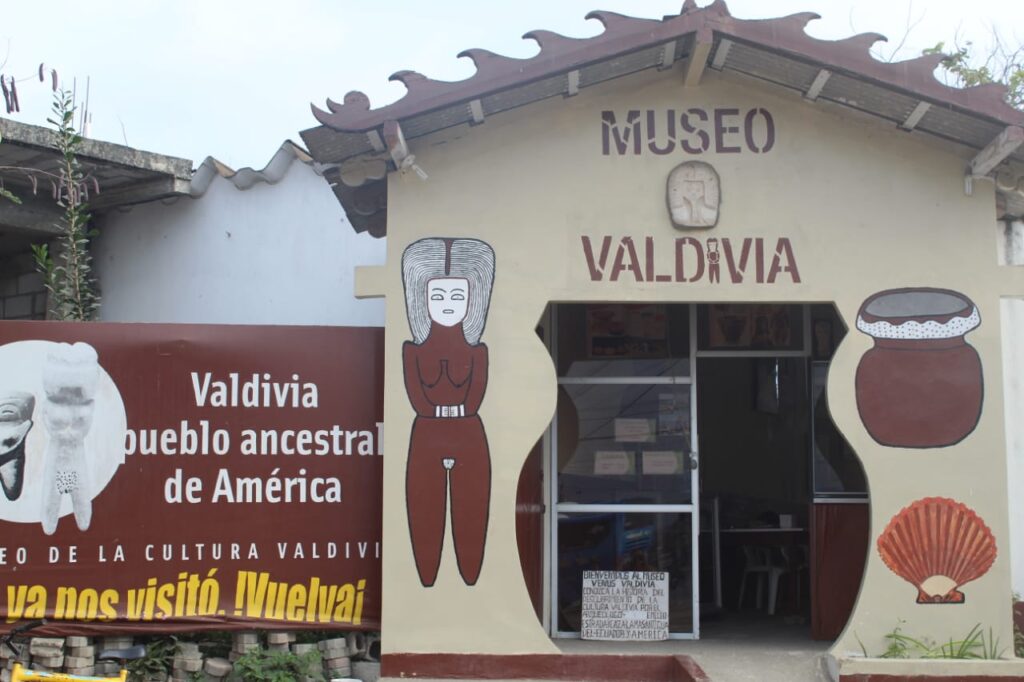
The deep history of the region surrounding Olón does not begin with colonial exploration or the expansion of the Inca Empire, but rather with the dawn of settled agricultural life in the New World. The Santa Elena peninsula is globally renowned among archaeologists as the cradle of the Valdivia culture, a remarkable formative society that flourished between roughly 3300 BC and 1500 BC.
The discovery of this ancient culture occurred in 1956 when the pioneering Ecuadorian archaeologist Emilio Estrada identified significant coastal remains just a short distance south of Olón. Subsequent excavations by international teams revealed that the Valdivia culture represented one of the earliest established ceramic-producing societies in the Western Hemisphere. For centuries, mainstream history assumed that complex pottery and settled villages developed much later in South America, but the discoveries along this coast completely rewrote the archaeological timeline.
The early inhabitants of the lands around Olón lived in egalitarian communities, constructing circular or oval dwellings arranged around a large central plaza. These people achieved a highly successful, balanced relationship with their environment. They combined early agricultural practices—cultivating maize, kidney beans, squash, cassava, and chilli peppers—with a deep reliance on the ocean. The pristine marine ecosystem of Olón provided an abundance of fish and molluscs, allowing these early settlements to thrive without the need for constant migration.
The most iconic legacy of this period is the Venus of Valdivia. These tiny, beautifully carved stone and ceramic figurines depict stylised human forms, predominantly female, displaying intricate hairstyles and expressive features. Excavated from domestic hearths and ancient refuse sites across the peninsula, these figurines are widely believed by historians to be fertility symbols or ritual objects connected to early agricultural cycles. The artistic sophistication of these ceramics, crafted more than four millennia ago, serves as a testament to the cultural maturity of the region long before European contact.
The Galápagos.
Ecuador’s Enchanted Isles
The sacred highway of the Spondylus shell
As centuries progressed, the small coastal settlements near Olón became integrated into a vast, complex trading network that stretched across the Andean world. The foundation of this economic and spiritual exchange was a humble bivalve mollusc: the Spondylus shell.
Characterised by its striking red, orange, and purple exterior spikes, the Spondylus princeps shell thrived in the warm equatorial waters off the coast of Santa Elena. To the pre-Columbian civilisations of the Andes, including the later Manteño-Huancavilca culture, this shell was far more valuable than gold. It was revered as a sacred object, a symbol of rain and agricultural fertility, and an essential offering to the gods. Because the presence of Spondylus fluctuated with changing ocean currents, its appearance was also used by ancient mariners to predict weather patterns and seasonal shifts.
Olón sat directly on what is now celebrated as the Ruta del Spondylus. Ancient seafaring merchants utilised large balsa wood rafts equipped with sophisticated cotton sails to transport these sacred shells from the coastal waters of Santa Elena northward to Mesoamerica and southward to the high kingdoms of Peru. The trade network was highly organised, and the shell functioned effectively as a primitive form of currency across thousands of miles.
This deep commercial connection infused the coastal communities near Olón with a sophisticated understanding of navigation and maritime trade. The local populations were not isolated coastal dwellers; they were active participants in a global network of exchange that shaped the geopolitics of ancient South America.
The Ecuadorian Sierra.
Get lost in the hills
From colonial isolation to an artisanal fishing commune
Following the Spanish arrival in South America during the early sixteenth century, the coastal strip containing Olón underwent a period of relative isolation. While the Spanish Empire focused its administrative and extractive energies on the gold-rich Andean highlands and the bustling port city of Guayaquil, the small settlements along the Santa Elena coastline reverted to a quiet, self-contained existence.
During the colonial era and into the early years of the Ecuadorian republic, the people of Olón sustained themselves through artisanal fishing and small-scale agriculture. The geography of the region, defined by the rugged Chongón-Colonche mountain range meeting the Pacific Ocean, created a natural barrier that limited heavy terrestrial traffic. As a result, the community developed a fierce sense of independence and a deep connection to the land and sea.
In the late nineteenth and early twentieth centuries, the social structure of the region solidified around the system of comunas. These were legally recognised communal landholdings where local families managed resources collectively, preserving indigenous and ancestral traditions of governance. While the discovery of oil in the nearby town of Ancón in 1914 brought rapid industrialisation and economic upheaval to parts of the Santa Elena peninsula, Olón largely retained its pastoral, community-focused character. The local economy revolved around the tides, with fishermen launching wooden boats directly into the surf each morning, employing techniques passed down through generations.
Spiritual heights and the clifftop sanctuary
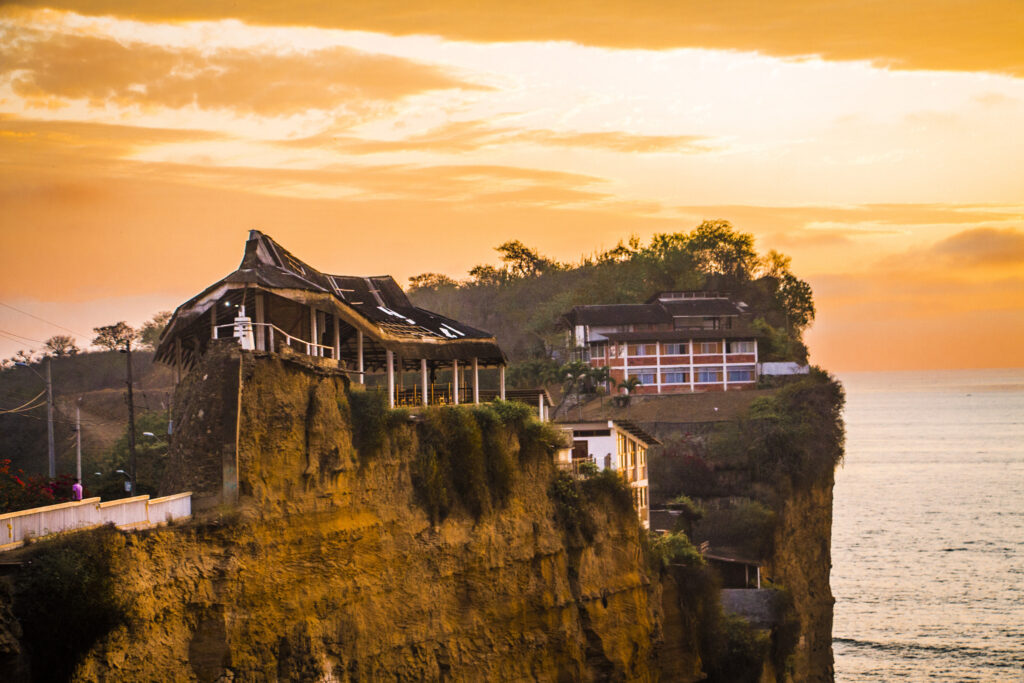
The twentieth century brought new cultural definitions to Olón, blending traditional coastal life with profound spiritual milestones. One of the most significant landmarks in the modern history of the village is the Santuario Blanca Estrella del Mar, or the Sanctuary of the White Star of the Sea.
Perched dramatically atop a high clay cliff just south of the village, this sanctuary marks the physical and cultural boundary between Olón and its bustling neighbour, Montañita. Consecrated on 8 September 1984, the sanctuary was designed in the distinct shape of a marine vessel, complete with a high prow that looks out over the vast expanse of the Pacific Ocean. The church was built to honour the Virgin of the Star of the Sea, the patron saint of mariners and fishermen.
The history of the sanctuary is deeply intertwined with a local religious phenomenon. In 1990, a small ceramic statue of the Virgin Mary housed within the sanctuary reportedly began to weep tears of blood. This event transformed the quiet fishing village into a major pilgrimage site, attracting thousands of devout visitors from across Ecuador and South America. The sanctuary remains a powerful cultural anchor for the community, symbolising the deep relationship between the maritime hazards faced by local fishermen and their enduring spiritual faith.
The Ecuadorian Amazon.
The most biodiverse place in the world
The modern rebirth of a slow travel haven

In the latter decades of the twentieth century, the entire coastline of Santa Elena began to experience a dramatic tourism boom. Nearby Montañita evolved rapidly from a hidden hippie surf spot into an international destination famous for its vibrant nightlife and intense crowds.
Faced with this encroaching development, the community of Olón made a conscious historical pivot. Rather than replicating the high-energy commercial expansion of its neighbour, Olón leveraged its traditional, communal roots to position itself as a bastion of sustainable, independent travel. The town transformed its economy from pure artisanal fishing to community-driven hospitality, ensuring that new hotels, restaurants, and surf schools remained locally owned and aligned with the peaceful character of the village.
Today, Olón stands as a perfect realisation of the slow travel philosophy championed by Wheely Tyred. It is a place where history is not confined to a museum but is felt in the daily rhythm of life—from the morning seafood markets on the sand to the quiet dirt roads that lead inland toward the protected tropical forests of the Chongón-Colonche hills. For the independent traveller, exploring Olón offers an opportunity to connect with an authentic coastal lineage that has survived and adapted across five thousand years.
Frequently asked questions about the history of Olón
While Montañita developed rapidly into an international nightlife hub with dense crowds, Olón made a conscious historical pivot towards sustainability. The village utilised its traditional communal roots to foster a quiet, slow travel environment, ensuring that guesthouses, restaurants, and surf schools remain predominantly locally owned and integrated into the peaceful rhythm of the community.
The surrounding Santa Elena province is globally significant due to the discovery of the Valdivia culture in 1956 by Ecuadorian archaeologist Emilio Estrada. Flourishing over four millennia ago, this formative society produced some of the earliest complex pottery in the Americas, including the famous Venus of Valdivia figurines. These discoveries completely redefined the timeline of ancient settled civilisations in South America.
The Ruta del Spondylus was an ancient, highly organised maritime trade network. The spiny Spondylus princeps mollusc thrived in the warm waters off Santa Elena and was revered by Andean civilisations as a symbol of fertility and rain. Local mariners used advanced balsa wood rafts to transport these shells thousands of miles north and south, connecting Olón’s ancestors to a vast geopolitical and economic network.
The Santuario Blanca Estrella del Mar is located on the high ridge just south of the village, marking the boundary between Olón and Montañita. Consecrated in 1984 to honour the patron saint of mariners, it became a major South American pilgrimage site in 1990 following reports that a statue of the Virgin Mary was weeping tears of blood. It is easily reached on foot, by bicycle, or via local buses running along the main coastal road.
Much of the land and resource management in the region is still influenced by the comuna system—communal landholdings managed collectively by local families. For the independent traveller, this system is the reason Olón has retained its authentic, unblemished character. It prevents aggressive corporate overdevelopment and ensures that your travel spend directly supports the local population.
Yes. The geography of Olón is defined by the rugged Chongón-Colonche mountain range meeting the Pacific Ocean. Independent travellers using bicycles or walking can easily head inland along quiet dirt roads to explore the protected tropical forests. This offers an excellent opportunity to experience the local agricultural heritage and diverse ecosystems that have sustained the region for five thousand years.
Ecuador.
Pure wonder on the equator.