Riding the path of fire and water / A deep dive into the history of Baños de Agua Santa
Discover the rich history of Baños de Agua Santa in Ecuador, from ancient thermal springs to the legendary Ruta de las Cascadas
Where volcanic wrath meets sacred waters
BEN FINCH
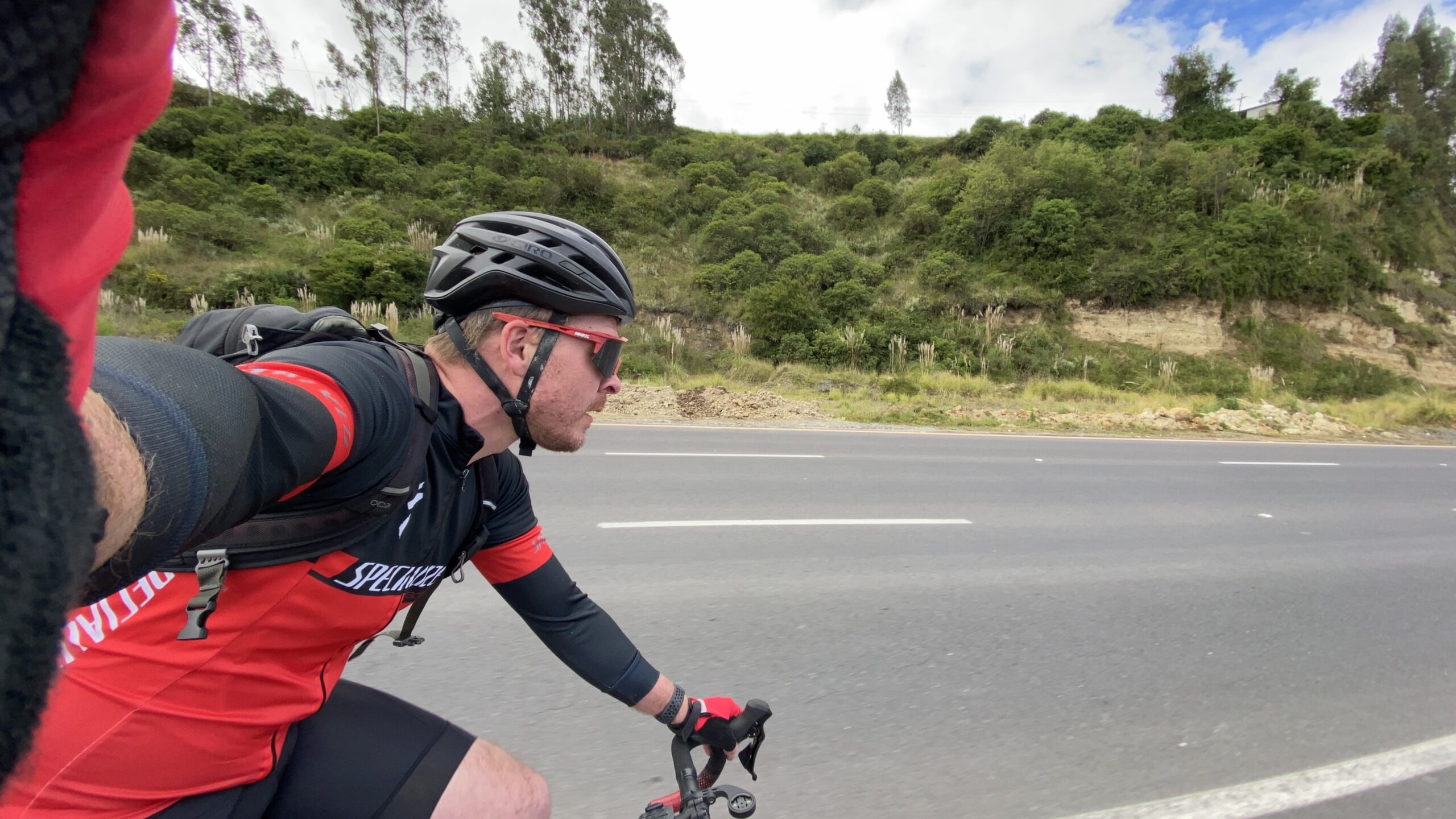
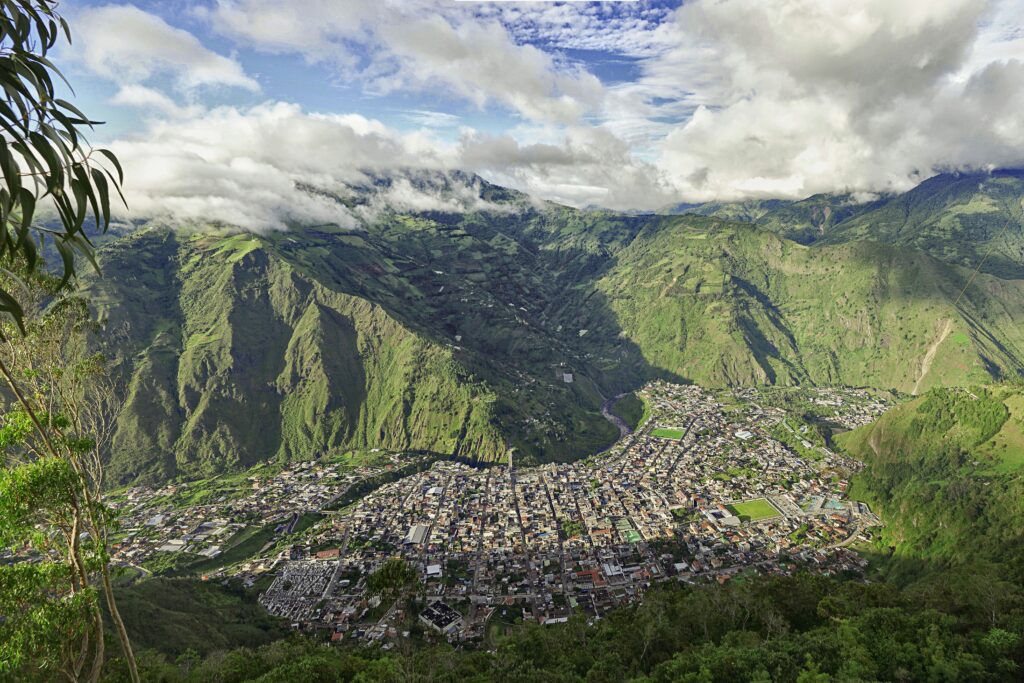
Nestled in a dramatic valley where the rugged Andean highlands transition into the lush foothills of the Amazon basin, Baños de Agua Santa stands as one of the most geographically and historically compelling destinations in Ecuador. Known to many contemporary travellers as a playground for adventure sports and a premier cycling destination, this vibrant mountain town is fundamentally shaped by a dual heritage of geological volatility and deep spiritual devotion. To cycle through its streets and along its plunging valley walls is to traverse a landscape carved by fire, blessed by mineral-rich waters, and rebuilt time and again by a remarkably resilient local population.
For the independent traveller, understanding the history of Baños de Agua Santa transforms a standard cycling excursion into a journey through centuries of human adaptation. The very features that draw modern cyclists—the deep gorges, the sheer cliff faces, the natural thermal pools, and the cascading waterfalls—are the direct products of a historical relationship between the local community and the active stratovolcano that looms overhead. By exploring this history, we gain a profound appreciation for the paths we ride and the communities that guard them.
An independent traveller’s guide to the resilience and landscapes of Baños
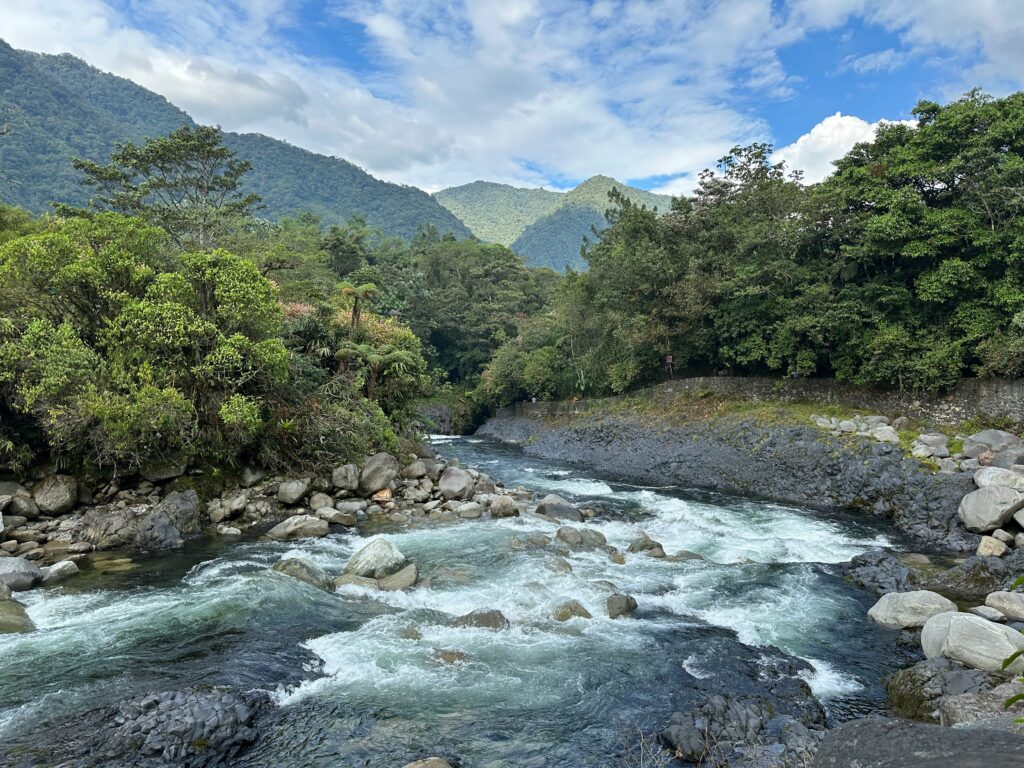
Before you set off down the dramatic Pastaza canyon or soak in the thermal springs, take a moment to understand the physical and cultural landscape of this remarkable Andean gateway. These key themes and practical locations define the unique history and enduring spirit of Baños de Agua Santa:
- Mama Tungurahua: The towering, active stratovolcano that has shaped the town’s geography, thermal waters, and local identity for centuries, viewed historically as a powerful maternal deity
- The healing waters: Rich mineral springs heated deep within the earth that served as a pre-colonial geothermal sanctuary before becoming the foundation for the town’s modern name and spa culture
- Basílica de Agua Santa: A sanctuary built from dark volcanic stone that has stood since 1944 as both a spiritual epicentre and a physical refuge during volcanic eruptions
- The great return of 2000: The historic, defiant march of local citizens who bypassed military blockades to reclaim and rebuild their ash-covered town after the 1999 evacuation
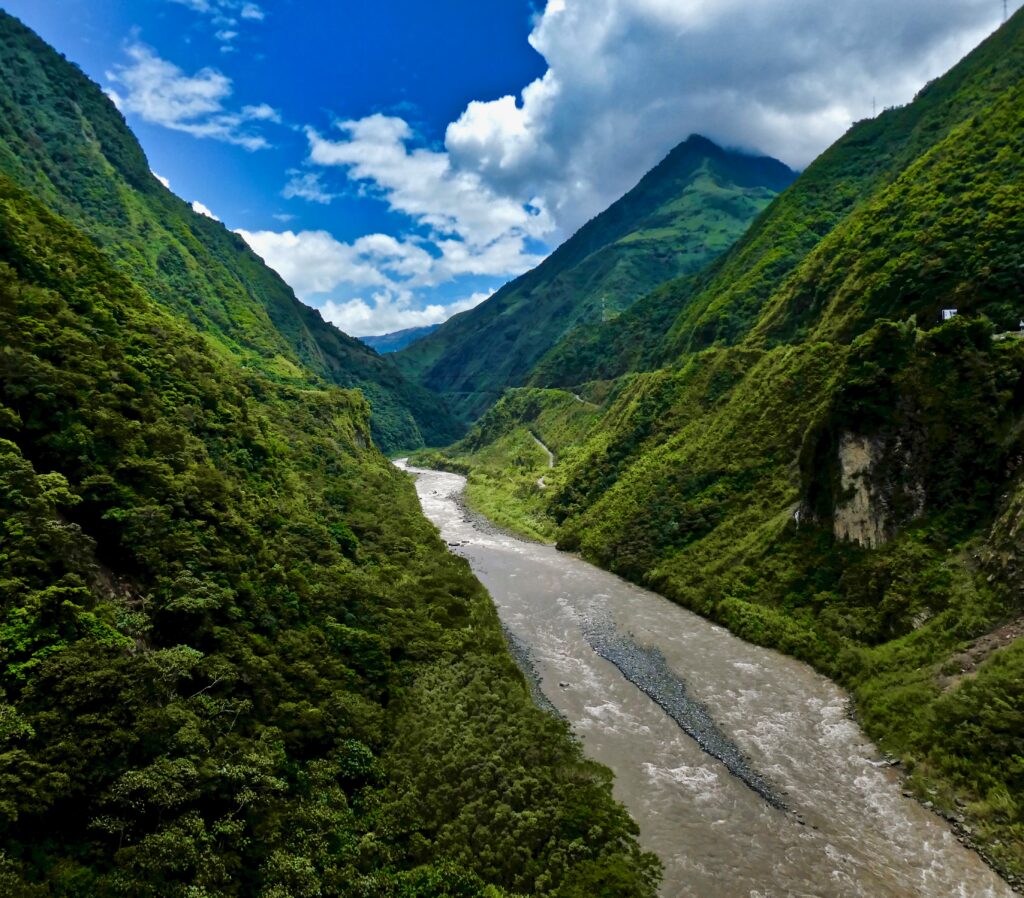
- Ruta de las Cascadas: A spectacular 18-kilometre cycling route tracing an old trade trail down the Pastaza canyon, carved directly into sheer volcanic cliffs
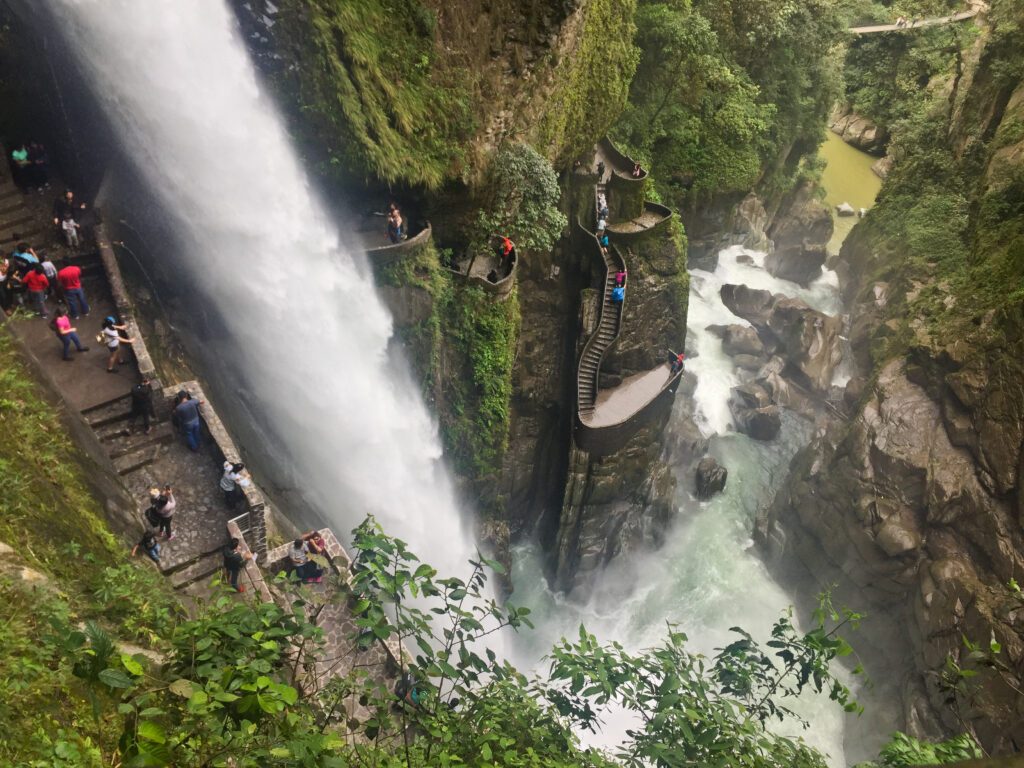
- Pailón del Diablo: The thunderous Devil’s Cauldron waterfall in Río Verde, where the raw physical force of nature is experienced from hand-carved stone steps and suspension bridges
- Melcocha and street life: The traditional craft of pulling and stretching boiled cane sugar over wooden pegs on doorway frames, a sweet culinary heritage preserved by local families
The Ecuadorian Sierra.
Get lost in the hills
Mama Tungurahua / The active goddess shaping the valley
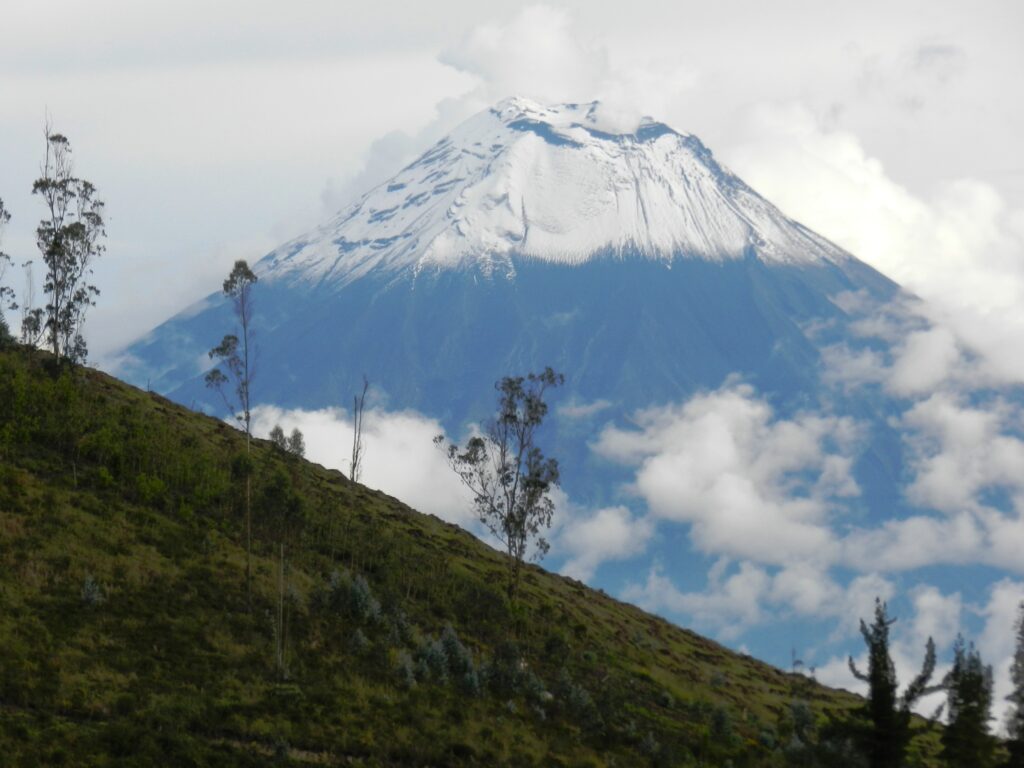
Long before the arrival of European explorers, the geographical basin of Baños de Agua Santa was recognised as a sacred place of elemental power. The towering, snow-capped peak of Volcán Tungurahua, rising to 5,023 metres above sea level, dominated the horizon and the cultural imagination of the region’s early indigenous inhabitants. These ancient peoples, likely descended from early Amazonian and Andean transition cultures who migrated along the Pastaza river basin, viewed the volcano not merely as a mountain, but as a living deity. They referred to her affectionately and with immense respect as Mama Tungurahua, a powerful maternal force capable of both nurturing life and unleashing terrifying destruction.
The active geological nature of Volcán Tungurahua created a unique geothermal system beneath the valley floor. High-pressure mineral waters, heated deep within the earth and enriched with sulphur, iron, and magnesium, bubbled up to the surface in natural springs near the base of the mountains. Long before the first colonial structures were erected, native groups travelled to these thermal pools to bathe, viewing them as sacred gifts from Mama Tungurahua. These waters were believed to possess supernatural healing properties, serving as a natural apothecary for physical ailments and spiritual cleansing. This ancient connection established the foundation of the town’s identity as a sanctuary of water, a characteristic that would endure through successive centuries of cultural transformation.
From Dominican mission to the miracle of the Virgin
The arrival of the Spanish Empire in the 16th century initiated a profound shift in the governance and spirituality of the region. In 1553, the Spanish crown assigned the religious Order of the Preachers, commonly known as the Dominican friars, the monumental task of evangelising the challenging territories of Canelos and Bobonaza. The remote outpost that would eventually become Baños de Agua Santa was initially established in 1570 as a basic missionary settlement and refuge. Because of its strategic position at the edge of the mountains, the settlement functioned primarily as a tambo—a critical rest stop and supply depot for missionaries, traders, and soldiers descending from the high Andes into the dense, unexplored wilderness of the Amazon basin.
As the Dominicans sought to convert the local populations, they witnessed the deep indigenous reverence for the local thermal springs and waterfalls. Rather than attempting to suppress this geological devotion, the missionaries adapted it, blending the pre-colonial beliefs with Catholic theology. The critical turning point in this spiritual synthesis occurred in the late 16th century with the legend of the Virgin of the Holy Water.
According to local historical records, a humble church sacristan witnessed a vision of the Virgin Mary descending from the skies, accompanied by two angels, to rest at the foot of a roaring waterfall that cascaded down the mountain. The Virgin requested that a chapel be built at the site, promising protection for the inhabitants against the unpredictable fury of the volcano. Not long after this event, a mysterious, ownerless mule carrying a massive wooden crate walked into the town square. When the townspeople and the local priest opened the crate, they discovered a magnificent, life-sized statue of the Virgin Mary. The statue was declared a divine gift, installed in the chapel, and became the revered patron saint of the valley: Nuestra Señora del Rosario de Agua Santa.
The Ecuadorian Amazon.
The most biodiverse place in the world
The fortress of faith / Basílica de Nuestra Señora del Rosario de Agua Santa
As the fame of the miraculous Virgin spread across the Real Audiencia de Quito and beyond, the small mountain settlement evolved into a major pilgrimage site. To accommodate the thousands of devout travellers who arrived on foot and horseback, the community began constructing a grand sanctuary. The building of the current Basílica de Nuestra Señora del Rosario de Agua Santa was a monumental, multi-generational undertaking. Initiated on 11 February 1904 under the passionate leadership of the Belgian Dominican priest Father Thomas Halflants, the construction spanned four decades, finally reaching completion in 1944 under Fray Sebastián Acosta.
The architectural design of the basilica is a striking example of semi-Gothic style, constructed almost entirely from dark, hand-carved volcanic stone quarried directly from the surrounding valleys. This choice of material was both aesthetic and deeply practical. Throughout its history, the heavy stone structure has served as a physical fortress of survival. When Volcán Tungurahua erupted periodically over the centuries, showering the valley in ash and volcanic debris, the sturdy stone basilica remained standing, acting as a literal bomb shelter for the terrified residents of the town.
Step inside the quiet, cool interior of the basilica today, and the walls tell the story of the town’s survival. A series of vast, dramatic murals painted in the mid-20th century by the celebrated indigenous artist Fray Enrique Mideros depict the historical miracles of the Virgin of the Holy Water. These paintings show scenes of dramatic volcanic eruptions, catastrophic earthquakes, and raging fires, with the Virgin consistently shielding the faithful and their stone sanctuary from destruction. The artwork offers a fascinating, visual record of the geological challenges the town has faced and the deep-seated faith that has sustained its people.
The great exodus and return of 1999
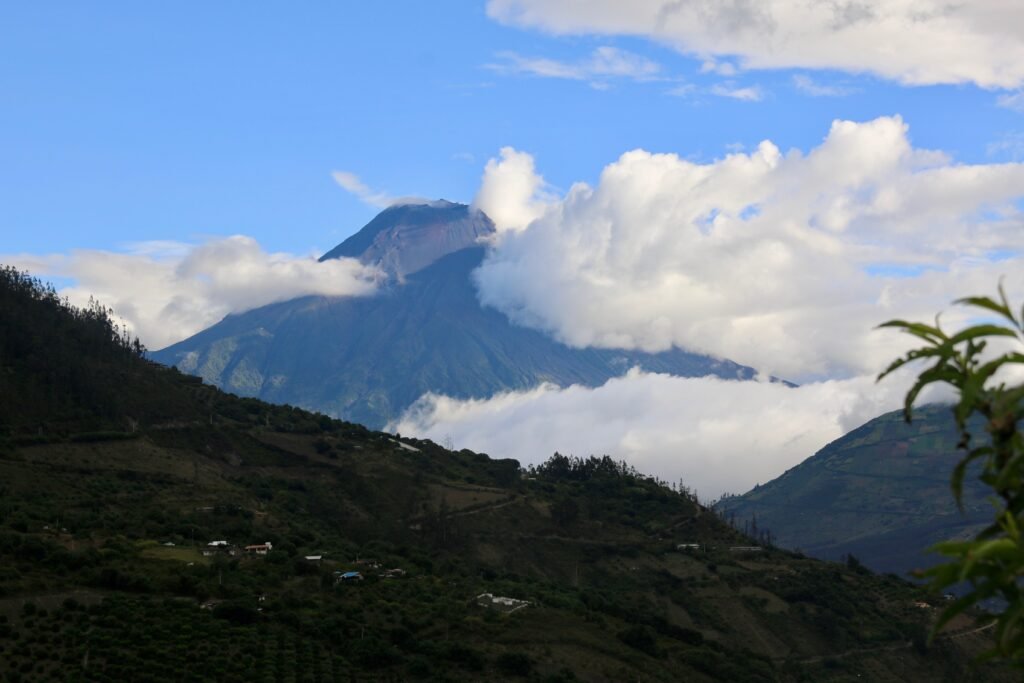
While the historical legends of Baños are captivating, its most defining modern chapter unfolded at the close of the 20th century. After decades of relative quiet, Volcán Tungurahua awoke with sudden, violent intensity in October 1999. Plumes of dark ash billowed thousands of metres into the sky, and scientific monitoring suggested a catastrophic eruption was imminent. Fearing for the lives of the population, the national government ordered the immediate, mandatory evacuation of all 17,000 residents of Baños de Agua Santa.
The town was closed, declared a military-controlled red zone, and its citizens were scattered across temporary shelters in neighbouring cities like Ambato and Pelileo. For the people of Baños, this was an era of immense hardship. The evacuation coincided with a devastating nationwide economic crisis, during which Ecuador abandoned its national currency, the sucre, in favour of the United States dollar. Stranded without livelihoods, homes, or governmental support, many residents feared they would never be allowed to return to their beloved valley.
In early 2000, after three painful months of exile and witnessing no major, catastrophic destruction of their homes, the residents of Baños reached a breaking point. Demonstrating an extraordinary display of civic unity and defiance, thousands of citizens organised themselves, marched past military blockades, and forced their way back into the barricaded town. Though the confrontation was tense and resulted in tragic clashes, the determined locals successfully reclaimed their city.
They immediately set to work cleaning the thick layers of grey ash from their roofs, restoring power, and reopening their businesses. This dramatic historical event cemented the modern identity of the people of Baños as a community of fierce independence and unbreakable resilience, qualities that continue to define the welcoming, self-reliant character of the town today.
The Galápagos.
Ecuador’s Enchanted Isles
Ruta de las Cascadas / Tracing history on two wheels
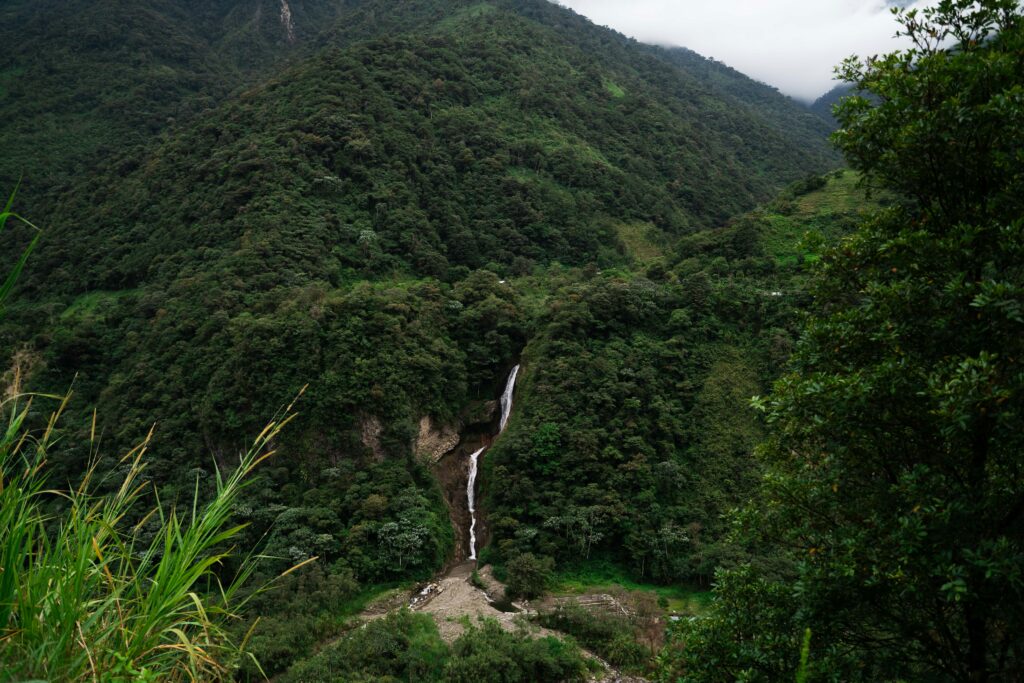
For the modern cycling enthusiast, the ultimate way to connect with this legacy of resilience, geological drama, and engineering triumph is by riding the legendary Ruta de las Cascadas. This iconic route, which runs roughly 18 kilometres from the mountain air of Baños down to the lush subtropical village of Río Verde, follows the old trade path along the steep canyon of the Río Pastaza. Historically, this route was a treacherous, narrow dirt track used by mules to transport goods between the Andean highlands and the Amazonian lowlands.
Over the 20th century, the trail was gradually transformed into a road, requiring monumental engineering feats to carve pathways and tunnels directly into the sheer cliff walls of solid volcanic rock. Today, a smooth asphalt road exists, alongside purpose-built cycling paths that detour safely around the dark, vehicle-heavy tunnels.
Setting out from Baños, the descent is a thrilling showcase of natural history. To your right, the Pastaza river cuts deeply through volcanic basalt, creating a spectacular gorge. Along the way, you pass a succession of dramatic waterfalls, each with its own place in the local landscape:
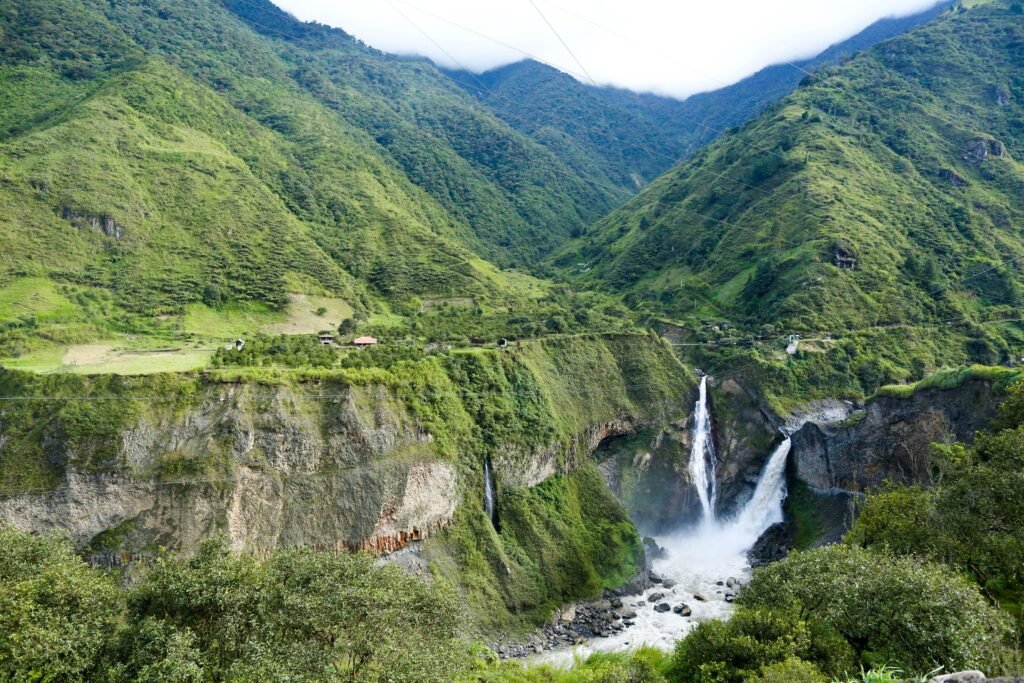
- Cascada Agoyán: Located just a few kilometres outside of town, this powerful waterfall is historically significant as one of the first major natural landmarks noted by early travellers. Today, it is also home to one of Ecuador’s oldest hydroelectric dams, showcasing how the region’s raw water power was harnessed to modernise the country
- Cascada El Manto de la Novia: This delicate, double-tiered waterfall cascades gracefully down the opposite side of the canyon, resembling a white bridal veil. Historically, local families crossed this deep chasm using rudimentary, hand-operated cable cars called tarabitas. Today, modernised versions of these cable cars offer a thrilling way to suspend yourself over the canyon and view the falls up close
- Cascada El Pailón del Diablo: Located in the parish of Río Verde, this thunderous waterfall is the crown jewel of the route. Translating to the Devil’s Cauldron, the falls occur where the green waters of the Río Verde plunge 80 metres through a narrow, swirling rock basin. The sheer force of the water creates a permanent mist that coats the surrounding tropical foliage. Walking down the hand-carved stone steps and crossing the historic suspension bridge at the foot of the falls allows you to feel the physical energy of the landscape that has awed travellers for centuries
The Ecuadorian Coast.
Where you’ll find the very best food
Tips for mindful slow-travel
To truly experience the Ruta de las Cascadas as a mindful traveller, Wheely Tyred recommends taking your time and engaging with the living history along the way. Avoid the temptation to simply rush downhill to the final waterfall. Instead, make frequent stops to support the local communities that have built their lives in the shadow of the volcano.
Stop at the small, roadside stalls to try melcocha, a traditional, incredibly stretchy sweet made from boiled cane sugar. This local delicacy is hand-pulled and stretched over wooden pegs attached to doorframes, a culinary tradition passed down through generations of Baños families. Take time to chat with the local business owners, many of whom remember the great evacuation of 1999 and can share personal stories of their return and the rebuilding of their town.
When your ride is complete, catch a local open-air truck, known as a chiva, to transport you and your bicycle back up the valley to Baños. End your day by visiting the ancient Termas de la Virgen at the base of the waterfall in the town centre. Immersing your tired muscles in the warm, yellow, mineral-rich volcanic waters is not just a relaxing end to a spectacular bike ride—it is a direct connection to a therapeutic bathing ritual that has been practised in this very spot for hundreds of years.
Frequently asked questions about the history of Baños de Agua Santa
Most independent travellers use Ecuador’s reliable and affordable long-distance bus network. From Quito, you can take a direct bus from the Terminal Terrestre Quitumbe in the south of the city; the journey takes around three to four hours as it winds down the Avenue of the Volcanoes. From Guayaquil, buses depart regularly from the main terminal near the airport, climbing up from the coast into the Andes over approximately six hours.
Yes, but it requires awareness. Volcán Tungurahua is closely monitored by the Instituto Geofísico of Ecuador. While the volcano has been relatively quiet in recent years, it remains active. Local authorities have well-established evacuation routes and early-warning sirens. When visiting, keep an eye on local geological reports and respect any temporary trail closures or safety notices.
The route is predominantly downhill, making it highly accessible even for casual cyclists. You can rent a reliable mountain bike from numerous local shops in the centre of Baños. Always ensure the shop provides a helmet, a pump, and a basic repair kit. While much of the route now features a dedicated cycle path, you will occasionally share the road with vehicles, so keeping left and staying alert is essential.
You do not have to pedal back up the steep 18-kilometre incline. In the village of Río Verde, near the Pailón del Diablo waterfall, local drivers operate custom open-air trucks called chivas. For a small fee, they will load your bicycle onto the roof rack and drive you comfortably back up the valley to the centre of Baños.
The thermal pools, such as the Termas de la Virgen located right beneath the waterfall in town, are a deeply local experience. To join the residents, you will need to pay a small entry fee, wear a swimming cap (which can be rented or bought at the entrance), and shower thoroughly before entering the water. The pools vary in temperature from icy cold to intensely hot, and the mineral-rich water has a distinct yellow-brown hue due to high sulphur and iron content.
Melcocha is a traditional artisanal toffee made from local sugar cane. As you walk through the streets of Baños, particularly near the bus station and the central plaza, you will see vendors vigorously pulling and throwing the warm, elastic sugar paste over large wooden pegs set into their shop doorframes. Watching the sugar transform from a dark syrup into a golden, chewy sweet is a fascinating local spectacle, and buying a warm piece directly from the maker is a fantastic way to support local family businesses.
Ecuador.
Pure wonder on the equator.