The best SIM cards and eSIMs for Ecuador / Local networks, costs and coverage (2026)
Comparing Claro, Movistar, and travel eSIMs for reliable mobile data across mainland Ecuador and the Galápagos Islands

Stay connected from high Andean passes to remote coastal roads
BEN FINCH
Staying connected while travelling across Ecuador presents a distinct set of geographical and administrative considerations. From navigating the high-altitude cobblestones of Quito to cycling through the Andean passes of Cotopaxi, trekking the Amazonian gateway of Tena, or sailing between the volcanic outcroppings of the Galápagos archipelago, mobile data is essential for route planning, safety, and remote work.
Because Ecuador uses the United States dollar (USD) as its official currency, comparing rates between local physical prepaid cards and digital travel eSIMs is remarkably straightforward.
However, navigating local registration regulations, identifying network frequency compatibility, and choosing between local physical infrastructure and pre-activated digital eSIM profiles requires an understanding of how Ecuadorian telecommunications operate.
Connecting across Ecuador / Essential takeaways

Navigating Ecuador’s varied topography—from high Andean passes to tropical coastlines and island reserves—requires a clear cellular strategy. Here are the core insights for staying seamlessly connected on the road:
- Airport Inflation Warning: Steer clear of arrival hall kiosks at Quito and Guayaquil airports, where SIM prices are marked up heavily compared to official city-centre stores (Centros de Atención a Clientes)
- Claro for Remote Routes: If your itinerary involves bikepacking high-altitude páramo passes, traversing the Amazon Basin, or visiting the Galápagos, Claro delivers the undisputed deepest network footprint
- Movistar for Urban Value: Ideal for city hopping between Quito, Guayaquil, and Cuenca or cruising the Pacific Coast, Movistar offers competitive speeds and great value packages
- eSIM Convenience via Airalo & Saily: For frictionless, pre-landing activation that bypasses local registration queues, digital profiles like Airalo and Saily offer rapid setup right from your smartphone
- Unlimited Flexibility with Yesim: Remote workers and heavy data users can leverage Yesim’s flexible daily passes and mobile hotspot permissions to keep laptops connected anywhere
- Maritime Coverage with GigSky: Cruising between the remote volcanic shores of the Galápagos archipelago requires specialised satellite and offshore connectivity that standard land SIMs cannot match
- Pay-As-You-Go Border Transit: Overland travellers crossing land borders from Colombia or into Perú can use Drimsim’s non-expiring credit system to avoid juggling multiple regional SIM cards
The Ecuadorian Sierra.
Get lost in the hills
1. Practical mobile connectivity in Ecuador

Landing in Ecuador presents travellers with two primary methods for securing cellular data: purchasing a traditional physical prepaid SIM card upon arrival or activating a digital travel eSIM prior to departure. Each path carries specific trade-offs regarding cost, convenience, and time investment.
Mobile connectivity pathways in Ecuador
| Physical Prepaid SIMs | Digital Travel eSIMs |
| Claro / Movistar / CNT | Airalo, Yesim, Saily, etc. |
| Requires physical swap | Instant QR activation |
| Mandates passport registration | No identity checks required |
| In-person queue or email delay | Retains primary home number |
| Lowest cost per gigabyte | Best for multi-country travel |
For international visitors, the most important operational distinction lies in identity verification. Under regulations enforced by the Agencia de Regulación y Control de las Telecomunicaciones (ARCOTEL), all physical SIM cards sold within national territory must be formally tied to a validated identity document.
For non-residents, this means your passport details must be registered with the carrier before your line can transmit data or make calls.
A common pitfall for arriving travellers is attempting to buy a physical SIM card directly inside international arrival halls. At both Mariscal Sucre International Airport (UIO) in Quito and José Joaquín de Olmedo International Airport (GYE) in Guayaquil, third-party vendor kiosks frequently charge steep markups—often asking $25.00 to $40.00 USD for basic tourist packages that cost under $10.00 USD at official carrier stores in downtown city centres (Centros de Atención a Clientes).
If you require instant data upon landing to book a ride-hailing vehicle or navigate to your accommodation, acquiring a travel eSIM before departure eliminates airport queue friction and avoids inflated tourist prices.
Alternatively, if your device lacks eSIM hardware or you plan an extended stay requiring maximum data allowances at local rates, waiting until you reach a city centre to purchase a physical SIM remains a cost-effective choice.
2. The local network landscape / Physical SIMs
Ecuador’s mobile ecosystem is dominated by two primary private operators, alongside a smaller state-owned provider. Understanding the relative strengths, coverage boundaries, and registration rules of these networks is critical when selecting a physical SIM.
Claro Ecuador (CONECEL)
Claro, owned by the Latin American telecommunications conglomerate América Móvil, is the largest network operator in Ecuador, commanding approximately 60 per cent of nationwide mobile subscriptions.
- Market Share: ~60% (Market Leader)
- Network Footprint: Unrivalled in rural Sierra, Amazon Basin, and Galápagos
- Starter Chip Cost: $4.00–$5.00 USD
- Typical Package: 10 GB to 14 GB for $8.00–$10.25 USD (25–30 days validity)
- Registration Method: In-person CAC or email: activacionpasaporte@claro.com.ec
Coverage analysis
Claro’s infrastructure investment makes it the default recommendation for travellers leaving major urban centres.
It offers superior 4G LTE coverage along high-altitude mountain passes in the Andean páramo, remote stretches of the Pan-American Highway, deep rural villages, and gateway towns in the Amazon Basin like Tena and Puerto Misahuallí.
Importantly, Claro maintains the most robust cell network in the inhabited areas of the Galápagos Islands, specifically around Puerto Ayora on Santa Cruz Island and Puerto Baquerizo Moreno on San Cristóbal Island.
Pricing structure
A physical Chip Claro starter card typically costs between $4.00 and $5.00 USD, often bundled with introductory promotional data valid for 3 to 7 days. Once registered, users can top up (recargar) with standard prepaid packages (paquetes prepago):
- Short Stay: $3.00 USD for 3 GB–4 GB (7 days validity)
- Standard Travel: $5.00 USD for 6 GB–7 GB (15 days validity)
- Extended Travel: $8.00 to $10.25 USD for 10 GB–14 GB (30 days validity), which usually includes unlimited WhatsApp text messaging and zero-rated access to specific social media platforms
Passport activation process
Activating a Claro SIM card as a foreign national requires strict adherence to ARCOTEL identification rules. There are two methods to complete this:
In-Person Activation: Visit an official Claro Centro de Atención a Clientes (CAC) with your physical passport. A customer service agent will scan your identification, log your passport number against the SIM’s serial number (ICCID), and activate the line immediately
Email Activation: If you buy an unactivated Chip Claro at a supermarket (e.g., Supermaxi, Mi Comisariato) or pharmacy (e.g., Fybeca, SanaSana), you must complete a remote registration workflow:
- Insert the SIM into your phone and connect to Wi-Fi
- Take a clear photo of your passport’s photo page
- Email the photo to activacionpasaporte@claro.com.ec with your assigned Ecuadorian mobile number (found on the card packaging, beginning with 09) in the subject line
- Include your full legal name, passport number, and country of residence in the body text
- Within roughly two hours, you will receive a confirmation email. Once received, dial *611 from your phone to complete line provision
Movistar Ecuador (OTECEL)
Movistar, operating under the Telefónica umbrella, functions as the primary commercial alternative to Claro in Ecuador.
- Market Share: ~30% (Primary Challenger)
- Network Footprint: Exceptional urban 4G LTE; competitive along the Pacific Coast
- Starter Chip Cost: $4.00–$5.00 USD
- Typical Package: 6 GB for $5.00 USD / 14 GB for $10.25 USD
- Registration Method: In-person Movistar store with passport
Coverage analysis
Movistar operates excellent, high-speed 4G LTE networks across Ecuador’s main urban metropolitan corridors, including Quito, Guayaquil, and Cuenca.
It is highly competitive along the Pacific Coast (La Costa), providing reliable data throughput in coastal hubs like Manta, Portoviejo, Montañita, and Olón.
However, its coverage fades faster than Claro’s when entering deep rural mountain regions, remote Amazonian wilderness, or secondary islands in the Galápagos.
Pricing structure
Movistar’s prepaid combo packages are competitively priced alongside Claro’s:
- 7-Day Plan: $3.00 USD for roughly 3.5 GB of data
- 15-Day Plan: $5.00 USD for 6 GB–8 GB of data
- 30-Day Plan: $10.25 USD for 14 GB–15 GB of high-speed data, alongside unlimited calls to other Movistar lines and zero-rated messaging allowances
Passport activation process
Similar to Claro, Movistar lines must be registered to a passport before data transmission is enabled.
Foreign tourists should visit an official Movistar service centre with their passport. While informal street vendors may sell active SIMs, these are registered under third-party names and risk sudden deactivation by ARCOTEL audits.
Always ensure your line is registered directly to your legal passport details.
CNT Móvil (Corporación Nacional de Telecomunicaciones)
CNT Móvil is Ecuador’s state-owned telecommunications enterprise. While it maintains extensive fixed-line broadband infrastructure across the nation, its mobile operations hold a smaller percentage market share.
- Market Share: < 10% (State Operator)
- Network Footprint: Basic urban coverage; limited rural 4G LTE
- Suitability: Generally not recommended for short-term international tourists
While CNT occasionally offers cheaper promotional data rates, its rural 4G mobile coverage is markedly inferior to both Claro and Movistar. Furthermore, the passport registration process at public CNT offices can involve tedious administrative bureaucracy.
For international visitors, bikepackers, and remote workers moving across regions, CNT is rarely the optimal choice.
The Galápagos.
Ecuador’s Enchanted Isles
3. The best travel eSIMs for Ecuador

For travellers with eSIM-compatible smartphones, purchasing a digital travel plan offers immediate connectivity upon landing without navigating local language barriers or administrative passport registration procedures.
Below is a detailed analysis of five leading global eSIM providers that serve Ecuador.
Yesim
Yesim has established itself as a versatile option for international travellers, offering a hybrid model of fixed-volume data allowances alongside true unlimited data packages tailored for intensive data consumers.
- Network Backbone: Movistar / Claro local roaming partners
- Plan Options: Fixed GB bundles (3 GB–20 GB) & Unlimited Daily Passes
- Standout Features: Integrated virtual numbers, Ycoins reward system, hotspotting
- Best For: Digital nomads, remote workers, and multi-country journeys
Plan structure & pricing
Yesim offers both standard data packages (e.g., 3 GB, 5 GB, 10 GB, or 20 GB valid for 7 to 30 days) and unlimited daily data passes ranging from 1 to 30 days in duration.
Prices vary dynamically based on active promotions, but standard fixed packages generally hover between $4.00 and $3.50 USD per gigabyte, with unlimited options providing predictable costs for heavy remote work users.
Network infrastructure & performance
Yesim operates via international roaming agreements with major Ecuadorian providers, primarily connecting to Movistar and Claro network towers. This dual-partner backend ensures that if one signal drops in transit, your phone can automatically scan and hook into the alternative local operator, preserving signal continuity across provinces.
Key features & usability
- Tethering / Mobile Hotspot: Yesim fully permits mobile hotspot functionality on both fixed and unlimited tiers, making it an excellent choice for digital nomads needing to connect laptops or tablets in cafes
- Ycoins Loyalty System: Users earn credit (Ycoins) on every purchase and through app interactions, which can be applied directly to discount future data top-ups
- Virtual Numbers: The Yesim app allows users to purchase virtual phone numbers for receiving verification SMS codes, helping bypass multi-factor authentication (MFA) hurdles while travelling
Airalo
Airalo is one of the world’s most widely recognised travel eSIM marketplaces, built around a user-friendly mobile application that simplifies profile installation for first-time eSIM users.
- Network Backbone: Movistar (Otecel)
- Plan Names: Bacanet (Single Country) / LatamLink (Regional)
- Cost Range: $5.00 USD (1 GB) to $36.00 USD (10 GB) / Unlimited Options
- Best For: Casual vacationers seeking fast, reliable app deployment
Plan structure & pricing
Airalo provides single-country plans for Ecuador under the brand name Bacanet, alongside a broader South American regional package named LatamLink:
- Bacanet (Ecuador Local): Offers options starting from 1 GB for 3 days (approx. $5.00 USD), scaling up to 10 GB for 30 days ($36.00 USD), as well as unlimited daily data passes ranging from 3 to 30 days
- LatamLink (Regional South America): Covers 17 countries across Latin America (including Ecuador, Colombia, Perú, and Brasil). Prices range from $7.00 USD for 1 GB up to larger multi-gigabyte monthly packages
Network infrastructure & performance
In Ecuador, Airalo’s primary network partner is Movistar (Otecel). Because it anchors to Movistar’s infrastructure, Airalo offers high-speed 4G LTE connections throughout Quito, Guayaquil, Cuenca, and coastal resort towns.
However, travellers venturing deep into rural Amazonian regions or remote areas of the Galápagos may experience reduced signal coverage compared to direct Claro connections.
Key features & usability
Airalo’s standout strength is its frictionless app user interface. On modern iOS and Android devices, eSIM profiles can be installed directly through the app without manually scanning a QR code.
The app provides real-time data-tracking push notifications, letting you top up additional data with a few taps before your allowance expires.
Saily
Created by the team behind NordVPN (Nord Security), Saily focuses on connection security, privacy, and seamless global coverage.
- Network Backbone: Tier-1 Local Roaming Partners
- Plan Options: 1 GB, 3 GB, 5 GB, 10 GB, 20 GB (7 to 30 days validity)
- Key Strengths: Nord Security ecosystem, automated setup, competitive rates
- Best For: Security-conscious travellers relying on public Wi-Fi networks
Plan structure & pricing
Saily provides structured fixed-data bundles for Ecuador ranging from 1 GB (7 days) up to 20 GB (30 days).
Pricing is competitive within the global eSIM marketplace, with top-tier 10 GB and 20 GB packages offering low per-gigabyte costs for medium-term stays.
Network infrastructure & performance
Saily partners with local telecom networks across Latin America to deliver reliable 4G LTE coverage.
In Ecuador, it routes data through established national networks, providing stable connectivity in urban centres and major transit highways.
Key features & usability
- Security Integration: Backed by Nord Security, the Saily app is designed with privacy-first protocols. It is an ideal companion for travellers who frequently connect to unsecured Wi-Fi networks in airports, hostels, and cafes across South America
- Single Profile System: Saily uses a universal eSIM profile. Once installed on your device, activating new data packages for subsequent countries (such as crossing into Colombia or Perú) does not require downloading additional eSIM profiles; new plans activate automatically upon arrival
GigSky
GigSky stands out in the international eSIM marketplace due to its specialised mobility services, including offshore maritime data coverage and aviation connectivity.
- Network Backbone: Regional Terrestrial Partners + Maritime Satellite Roaming
- Plan Types: Terrestrial Country Plans, Regional LatAm, Offshore/Cruise
- Standout Features: In-flight data options, Galápagos cruise ship compatibility
- Best For: Cruise passengers sailing the Galápagos & transit travellers
Plan structure & pricing
GigSky provides standard local land packages for mainland Ecuador, regional Latin American passes, and specialised offshore maritime data plans.
While standard terrestrial plans are priced competitively against other market leaders, its specialised cruise plans carry higher costs per megabyte due to satellite routing overheads.
Network infrastructure & performance
On mainland Ecuador, GigSky uses local 4G LTE cellular infrastructure, delivering dependable speeds across urban and suburban zones.
Its unique advantage lies in its offshore capabilities: GigSky maintains roaming partnerships with maritime network providers (such as Wireless Maritime Services), enabling satellite-linked data transmission aboard select cruise vessels.
Key features & usability
For travellers embarking on multi-day liveaboard cruises through the Galápagos archipelago, GigSky is one of the few eSIM platforms offering plans that function offshore beyond the reach of island-based cellular towers.
Additionally, select Visa cardholders can access complimentary global data allowances through GigSky’s ongoing financial services partnerships.
Drimsim
Drimsim operates on a different business model than most travel eSIM providers, using a universal pay-per-megabyte structure rather than pre-purchased data bundles with fixed expiration dates.
- Network Backbone: Multi-network global roaming agreements
- Pricing Model: Pure Pay-As-You-Go (Pay per MB, no expiration dates)
- Hardware Options: Universal Physical SIM card or digital eSIM profile
- Best For: Slow travellers, overland backpackers, and low-data users
Plan structure & pricing
Drimsim does not sell 30-day 5 GB or 10 GB packages. Instead, users load credit into their Drimsim balance (e.g., €10 or €20 EUR), and data consumption is billed strictly per megabyte used based on local country rates.
In Ecuador, data costs roughly €0.015 to €0.03 EUR per megabyte. Crucially, your loaded balance and SIM line never expire, provided you use the card at least once a year.
Network infrastructure & performance
Drimsim functions via global multi-network agreements. Upon entering Ecuador, the Drimsim profile negotiates a connection with whichever local tower (Claro or Movistar) offers the strongest signal, switching networks dynamically as you travel between provinces.
Key features & usability
Drimsim is exceptionally well-suited for slow travellers and overland backpackers taking long journeys across South America. If you cross from Colombia into Ecuador and onward into Perú, you do not need to switch eSIM profiles or discard unused data packages. Your account balance remains active across all borders, making it an ideal low-cost backup line for navigation and messaging.
The Ecuadorian Amazon.
The most biodiverse place in the world
4. Comparative matrix / Physical SIMs vs travel eSIMs
To assist in evaluating your options, the table below compares Ecuador’s primary local physical operators against our five featured international travel eSIM partners across operational criteria.
Provider comparison matrix
| Provider | Type | Local Backbone | Setup Time | Passport? | Cost Range | Best Use Case |
| Claro | Physical SIM | Claro Ecuador | 30–60 mins | Yes | $4–$12 USD | Remote coverage, páramo & Galápagos |
| Movistar | Physical SIM | Movistar Ecuador | 30–60 mins | Yes | $5–$15 USD | Urban value, Quito, Guayaquil & Pacific Coast |
| Yesim | eSIM | Movistar / Claro | < 5 mins | No | Flexible / Unlimited | High-data users, nomads & hotspotting |
| Airalo | eSIM | Movistar | < 5 mins | No | $5–$36 USD | Frictionless app setup, short-term holidays |
| Saily | eSIM | Local Partners | < 5 mins | No | Competitive | Security-conscious travellers & open Wi-Fi |
| GigSky | eSIM | Regional Partner | < 5 mins | No | Tiered / Cruise Rates | Galápagos cruises & multi-modal transit |
| Drimsim | eSIM / Physical | Global Multi-Network | < 5 mins | No | Pay-Per-MB | Overland border crossers & light backup data |
Strategic trade-off analysis
- Cost vs Convenience: Physical SIMs from Claro or Movistar offer the lowest absolute price per gigabyte. However, they require finding an official store, presenting a physical passport, waiting for staff registration, and dealing with potential language barriers. Travel eSIMs cost slightly more per gigabyte but activate instantly, require no identity checks, and preserve your primary SIM slot
- Geographic Coverage Requirements: If your itinerary is concentrated in urban hubs like Quito, Guayaquil, and Cuenca, any provider (physical or eSIM) using Movistar or Claro infrastructure will perform well. If your trip involves remote cycling through Andean passes, deep trips into the Amazonian Oriente, or long stays in the Galápagos, selecting a physical Claro SIM or an eSIM with multi-network access (like Yesim) is preferable
5. Regional coverage / Mountains, coast, jungle, and islands
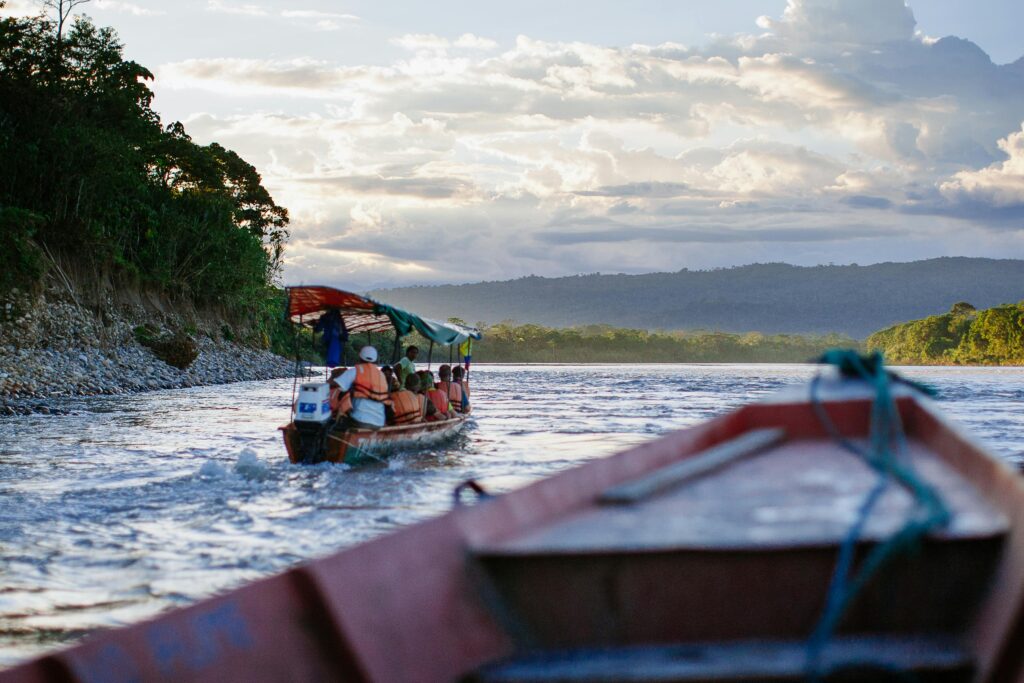
Ecuador’s geography is divided into four distinct climatic and topographical zones: the Andean Highlands (La Sierra), the Pacific Coast (La Costa), the Amazon Basin (El Oriente), and the Galápagos Islands (Insular). Mobile network signal behaves differently across each terrain.
The Andean Highlands (Sierra)
- Quito, Cuenca, Cotopaxi, Avenida de los Volcanes
- Urban valleys: Excellent 4G LTE across all carriers
- High passes / páramo: Signal shadowing in deep gorges; Claro dominates
The central spine of Ecuador features dense urban valleys bordered by massive volcanic peaks. Cities like Quito, Cuenca, and Ambato enjoy dense 4G LTE networks from both Claro and Movistar.
However, when cycling or driving along mountain passes—such as the loop around Cotopaxi National Park, the Quilotoa Traverse, or the high-altitude páramo ecosystems above 3,500 metres—topographical shadowing frequently blocks line-of-sight to cell towers. In deep mountain gorges, signal drops off quickly.
Claro maintains the highest density of rural mountain towers, making it the most reliable backbone for alpine trekkers and bikepackers.
The Pacific Coast (Costa)
- Guayaquil, Manta, Ruta del Spondylus, Montañita, Olón
- Coastal highways: Strong 4G coverage on Movistar and Claro
- Beach towns: Excellent capacity; occasional congestion during peak holidays
Stretching from the northern province of Esmeraldas down through Guayaquil to the Peruvian border, the Pacific coast features flat agricultural plains and coastal highways like the Ruta del Spondylus.
Both Movistar and Claro offer strong, continuous 4G LTE along coastal transit routes and within popular surf communities such as Montañita and Olón.
During national holiday weekends (such as Carnaval or Día de los Difuntos), beach towns experience large tourist surges that can temporarily congest local cell towers, reducing data throughput during peak evening hours.
The Amazon Basin (El Oriente)
- Tena, Puerto Misahuallí, El Coca, Puyo
- Gateway hubs: Good 4G availability
- Deep rainforest lodges: Signal drops completely; satellite or Claro reliance
East of the Andes, the Amazonian slope drops into dense jungle terrain. Major transit gateway towns—including Tena, Puyo, Puerto Misahuallí, and Francisco de Orellana (El Coca)—have consistent 4G coverage.
However, as you travel further downriver via motorised canoe into protected primary rainforest or deep eco-lodges (such as those along the Napo or Yasuní rivers), terrestrial mobile signals fade completely.
Claro retains basic 3G/4G footprints in secondary river settlements, whereas Movistar signal is generally unavailable outside major Amazonian municipalities.
The Galápagos Archipelago
- Santa Cruz (Puerto Ayora), San Cristóbal (Puerto Baquerizo Moreno), Isabela
- Town centres: Reliable 3G/4G (Claro strongest)
- Open sea / Marine reserve: Zero terrestrial signal; GigSky cruise eSIM required
Located roughly 1,000 kilometres off the Ecuadorian mainland, the Galápagos Islands present unique connectivity constraints.
- Populated Settlements: In main town centres—such as Puerto Ayora on Santa Cruz Island, Puerto Baquerizo Moreno on San Cristóbal Island, and Puerto Villamil on Isabela Island—Claro operates functional 3G and 4G LTE cell towers. Movistar provides coverage in Puerto Ayora and Puerto Baquerizo Moreno, but its network is noticeably weaker or non-existent on Isabela
- Marine Reserve & Open Water: Once your vessel leaves port to navigate between uninhabited islands, terrestrial cell signal ceases entirely. Standard SIM cards and land-based travel eSIMs will display No Service. If you require connectivity while cruising open waters, specialised maritime eSIM packages (such as those offered by GigSky) or onboard satellite Wi-Fi services (such as Starlink Maritime) are necessary
The Ecuadorian Coast.
Where you’ll find the very best food
6. Technical setup, device unlocking & ARCOTEL rules

To ensure a smooth transition to an Ecuadorian mobile line, several technical prerequisites and configuration settings must be managed on your device.
Carrier unlocking
Before travelling to Ecuador, you must verify that your smartphone is completely carrier-unlocked. If your device was purchased under a contract or instalment plan from a domestic home provider (e.g., AT&T, Verizon, EE, or Vodafone), it may be software-locked to that specific home network.
Locked devices will refuse to accept foreign physical SIMs or travel eSIM profiles, displaying error messages such as SIM Not Supported. Contact your home carrier at least two weeks before departure to request an official network unlock.
Local cellular frequency bands
Ecuadorian cellular networks operate across specific radio frequency spectrum bands. Ensuring your mobile handset supports these frequencies is vital for maintaining 4G LTE speeds:
Ecuador spectrum allocation
| Network Generation | Frequency Band | Primary Carrier Usage |
| 3G UMTS / HSPA+ | Band 2 (1900 MHz) | Claro & Movistar |
| 4G LTE | Band 4 (AWS 1700/2100 MHz) | Claro & Movistar (Primary 4G) |
| 4G LTE | Band 2 (1900 MHz) | Secondary 4G Capacity Layer |
Modern North American, European, and Australasian flagship smartphones (such as Apple iPhone 11 and newer, Samsung Galaxy S20 and newer, or Google Pixel 4 and newer) fully support both Band 2 and Band 4 AWS frequencies.
If you are using an older budget handset purchased in Europe or Asia, double-check its hardware technical specifications to confirm compatibility with 4G LTE Band 4 (AWS).
Dual SIM management & data roaming settings
When using a digital travel eSIM alongside your primary home physical SIM, proper configuration of your device settings prevents accidental international roaming fees from your home carrier:
Dual SIM settings checklist
- Primary Home Line (Physical SIM)
- Voice & SMS: Keep ON (allows receiving 2FA security text messages)
- Data Roaming: Switch OFF (prevents home carrier charges)
- Secondary Travel Line (eSIM: Yesim / Airalo / Saily / etc.)
- Cellular Data: Set as DEFAULT DATA LINE
- Data Roaming: Switch ON (allows eSIM to connect to Ecuadorian towers)
- Cellular Data Switching
- Allow Cellular Data Switching: Toggle OFF (prevents auto-fallback to home SIM)
Physical Top-Up Procedures (Recargas)
If you choose a physical prepaid SIM from Claro or Movistar, you will eventually need to replenish your data balance. In Ecuador, topping up a line is known as making a recarga.
How to top up physical SIMs
- In-Person at Pharmacies & Supermarkets
- Locations: Fybeca, SanaSana, Cruz Azul, Supermaxi, Mi Comisariato, Tía
- Process: Approach the cashier and request a Recarga Claro or Movistar
- Details: Provide your 10-digit mobile number (09XXXXXXXX) and cash amount
- In-App or Online Payment Portals
- Official Apps: Mi Claro Ecuador app or Mi Movistar Ecuador app
- Method: Pay using international credit cards (Visa / Mastercard)
Once your cash recarga balance is credited to your line, you must activate a specific data combo package (combo or paquete) via the carrier’s USSD menu (e.g., dialling *123# or *100#) or through their mobile app.
Failing to explicitly activate a package will result in your credit balance being consumed at expensive standard pay-per-megabyte rates.
Quito.
Explore the Middle of the World
Get a signal for the Ecuadorian Road

Travelling independently across Ecuador is an exercise in dynamic contrasts. One day you are pedalling through the thin air of the Avenida de los Volcanes, and the next you are boarding a bus down toward the humid banana plantations of the coastal lowlands or navigating cobblestone streets in Cuenca.
In a country where geography changes as swiftly as the weather, having immediate access to reliable digital mapping, local bus schedules, and weather updates is far more than a convenience—it is a fundamental safety tool for the self-propelled traveller.
Whether you choose the low-cost route of registering a local physical SIM at a downtown service centre or opt for the effortless, pre-departure convenience of a digital eSIM, aligning your connectivity provider with your exact route is what matters most.
For deep rural wanderings, remote bikepacking tracks, and island journeys, physical infrastructure like Claro remains unbeatable.
For swift urban transits, digital nomads setting up temporary desks in mountain cafes, or multi-country backpackers, flexible eSIM profiles offer total freedom from local queues and identity verification friction.
Before you zip up your panniers or pack your rucksack, double-check that your handset is fully unlocked from your home network, verify frequency compatibility for Band 4 AWS, and load your initial data profile.
With your connectivity sorted before the journey begins, you can focus on the real reward of travelling in Ecuador: watching the Andean peaks emerge from the morning mist, sharing sweet local fruit at a roadside stall, and discovering what lies around the next bend in the road.
Affiliate Disclaimer: Some of the links on Wheely Tyred are affiliate links. If you click through and make a booking or purchase, we may earn a small commission at no extra cost to you. We only recommend gear, tours, stays, and services we genuinely use, trust, and stand behind — our editorial independence always comes first. These commissions help keep our independent cycling guides and travel stories free to read. Thanks for supporting the ride!
Frequently asked questions about the best SIM cards for Ecuador
While third-party retail kiosks exist inside the arrival halls at Mariscal Sucre International Airport (UIO) in Quito and José Joaquín de Olmedo International Airport (GYE) in Guayaquil, they frequently charge steep markups ($25.00–$40.00 USD) for basic tourist packs. It is far more economical to activate a digital eSIM before flying, or wait until you reach the city centre to purchase a physical SIM at an official carrier store for $4.00–$5.00 USD.
Yes. Under ARCOTEL regulations, all physical SIM cards sold in Ecuador must be registered against an official identification document. Non-resident foreign travellers must present their physical passport at an official carrier service centre (Centro de Atención a Clientes) or submit a copy via the official carrier activation email workflow. Digital travel eSIMs, by contrast, do not require passport registration.
Claro provides the most reliable and widest 3G/4G coverage across the populated settlements of the Galápagos, particularly in Puerto Ayora (Santa Cruz) and Puerto Baquerizo Moreno (San Cristóbal). Movistar offers coverage in main towns but fades on secondary islands like Isabela. Once your boat leaves port to navigate uninhabited islands or open waters, terrestrial signal ceases entirely, making specialised maritime eSIMs or satellite connectivity necessary.
Most modern smartphones are compatible. Local carriers rely primarily on Band 2 (1900 MHz) for 3G/4G and Band 4 AWS (1700/2100 MHz) for primary 4G LTE coverage. Unlocked handsets manufactured for North American, European, or Australasian markets generally support these bands without issue, but it is always wise to verify hardware specifications for Band 4 AWS prior to travel.
Topping up (hacer una recarga) a local physical SIM is straightforward. You can visit almost any major pharmacy chain (Fybeca, SanaSana, Cruz Azul) or supermarket (Supermaxi, Tía) across Ecuador. Simply provide the cashier with your 10-digit mobile number and cash in USD. Once credited, use the carrier’s USSD code menu or mobile app to activate your chosen data package (paquete).
Yes. Modern Dual SIM smartphones allow you to keep your primary physical SIM active for incoming phone calls or essential two-factor authentication (2FA) security text messages, while setting your travel eSIM as the dedicated line for cellular data. Just ensure that Data Roaming is turned OFF on your primary home line to prevent unexpected international roaming charges from your home provider.
Ecuador.
Pure wonder on the equator.