Cycling laws in Ecuador / Rights, rules, fines, and the 2027 legal reforms explained
Complete 2027 guide to bicycle regulations, cyclist rights, e-bike rules, traffic fines, and transit laws in Ecuador

Navigate Ecuador with clarity, confidence, and legal knowledge
BEN FINCH
Ecuador presents one of the most spectacular landscapes on the planet for anyone on two wheels. From the dramatic dirt tracks of the high páramo to the bustling urban thoroughfares of Quito, Cuenca, and Guayaquil, riding a bike here is an exhilarating experience.
However, pedal power alone is not enough to ensure a smooth journey. To ride safely and with complete peace of mind, you need a firm grasp of the legal framework governing Ecuadorian roads.
Building upon the foundations set out in the Wheely Tyred 2026 guide, this updated 2027 analysis incorporates significant statutory reforms passed by the National Assembly. These legislative updates affect everything from light electric personal mobility devices to automated traffic camera oversight.
Whether you are a local commuter weaving through morning traffic or an international tourer taking on the Pan-American Highway, understanding your legal standing is the best way to protect yourself and enjoy the ride.
Key legal takeaways for cycling in Ecuador

Navigating Ecuador on two wheels requires balancing an appreciation for its dramatic topography with an understanding of its statutory road framework. Here is a summary of the core legal rights, equipment requirements, and driver obligations governing cyclists across the country in 2027.
- Legal Right to the Road: Article 204 of the national transit law guarantees cyclists an equal right of access to all public thoroughfares, granting riders statutory priority over turning motor vehicles at non-signalised intersections and roundabouts
- E-Bike and Personal Mobility Rules: The 2027 statutory updates formally classify pedal-assist electric bicycles, permitting standard 25 km/h models on dedicated ciclovías while subjecting higher-powered throttle devices to stricter municipal speed caps
- Homologated Helmet Mandate: Certified headgear (cascos homologados) is compulsory in major metropolitan areas such as Quito, Cuenca, and Guayaquil, with commercial retailers legally required to bundle approved helmets at the point of sale
- Commercial Courier Standards: Courier and delivery cyclists operate under dedicated safety rules requiring certified helmets, retro-reflective vests or bands, and strict limits on cargo width to maintain vehicle stability
- Infrastructure and Lane Rights: Riders are legally obligated to use dedicated ciclovías where available, but retain the full statutory right to occupy the vehicle lane if the cycle path is obstructed, damaged, or flooded
- Automated Camera Transparency: Overhauled regulations for speed cameras (fotorradares) mandate clear warning signage 500 metres prior to detection points, preventing sudden motorist braking alongside cycle lanes
- Public Transit Integration: Interprovincial bus operators are legally mandated to carry bicycles in lower luggage compartments without predatory surcharges, while municipal transit systems provide dedicated off-peak carriage
The Ecuadorian Sierra.
Get lost in the hills
The 2027 legal landscape / What changed with National Assembly reforms?
The primary legal pillar governing all road users in Ecuador is the Ley Orgánica de Transporte Terrestre, Tránsito y Seguridad Vial. National statutes explicitly classify non-motorised transport as a fundamental priority within the national mobility hierarchy, ensuring that cyclists hold recognised statutory protections on public roads.
In late 2026, the National Assembly enacted sweeping updates to national transit legislation, establishing major updates that are now actively enforced in 2027. These statutory changes modernised road safety regulations to keep pace with rapid shifts in urban mobility and delivery services.
1. Formal regulation of e-bikes and personal light mobility devices
Previous legislation treated electric bicycles and light electric scooters as an unregulated grey area. The 2027 legal framework formally defines light electric vehicles based on power output and maximum design speed.
Standard pedal-assist bicycles that assist up to 25 km/h retain all traditional cyclist rights and ciclovía access. Faster electric bikes and throttle-driven devices face stricter municipal oversight and speed caps on dedicated cycle paths.
2. Homologated helmets and retailer obligations
National legislation now explicitly specifies that headgear used on bicycles, e-bikes, and scooters must meet approved safety standards (cascos homologados). Merely placing a non-certified plastic shell on your head no longer satisfies statutory requirements during municipal compliance checks.
Furthermore, commercial bicycle and e-bike retailers are legally obligated to bundle certified helmets at the point of sale, ensuring new riders are immediately equipped for compliance.
Whatever you think of cyclists being mandated to wear a helmet or not, it is the law in Ecuador.
3. Safety standards for commercial delivery riders
Recognising the massive growth of urban cycle delivery, national laws now mandate specific safety standards for commercial delivery cyclists. Delivery riders operating on public streets must wear certified homologated helmets, retro-reflective vests or high-visibility bands, and ensure their cargo containers do not exceed strict width and balance limitations.
4. Standardised speed and lane enforcement via automated fotorradares
A major legislative triumph for road safety in 2027 is the overhaul of automated traffic enforcement systems (fotorradares). In previous years, sudden unannounced speed traps led to aggressive driver braking near cycle lanes, creating severe collision risks.
The reformed law mandates that all municipal fotorradares must be certified, publicly registered, and preceded by high-visibility warning signage positioned at least 500 metres prior to the detection point. This creates far more predictable traffic patterns around dedicated cycle corridors.
Core rights / Your legal claim to the road in Ecuador

Ecuadorian law grants cyclists clear, enforceable rights on public thoroughfares. Knowing these rights enables you to ride assertively without feeling intimidated by larger motor vehicles.
Full access to public roads
Cyclists possess the explicit legal right to travel on all public roads throughout Ecuador. The only statutory exceptions involve high-risk infrastructure where non-motorised traffic is explicitly banned for safety reasons, such as fully enclosed mountain tunnels or express highways lacking dedicated cycle lanes or hard shoulders.
Primary right of way at intersections
At non-signalised intersections, roundabouts, and road junctions, cyclists hold preferential right of way over turning or entering motor vehicles. Drivers are legally required to yield to bicycles proceeding straight ahead or navigating roundabouts.
Lane ownership when infrastructure is absent or unsafe
If a designated cycle lane (ciclovía) is present, you are legally required to use it.
However, the law acknowledges practical realities: if a ciclovía is obstructed, severely damaged, flooded, or presents an immediate danger, cyclists retain the legal right to take the lane on the main carriageway.
When riding on roads without dedicated cycle infrastructure, cyclists have the right to occupy the full lane to ensure adequate lateral clearance from passing motor traffic.
Vulnerable road user legal standing
Ecuadorian traffic legislation formally integrates the principle of vulnerable road user protection. In legal terms, the heavier and more dangerous vehicle bears a higher duty of care. In the event of a collision or road incident, the judicial presumption places greater responsibility on the motorist, provided the cyclist was abiding by fundamental traffic rules.
The Ecuadorian Amazon.
The most biodiverse place in the world
Mandatory bicycle rules and technical equipment standards

While the law grants substantial protections, it also establishes clear, non-negotiable duties for everyone riding a bike in Ecuador.
Mechanical and safety equipment standards
Every bicycle ridden on Ecuadorian public roads must meet minimum technical standards:
- Braking Systems: Independent, fully functional front and rear brakes are mandatory
- Reflectors: Reflective devices must be fitted to the extremities of the bicycle, including pedals or wheel rims
- Night Lighting: Between sunset and sunrise, or during low-visibility weather conditions, bicycles must display a bright white light at the front and a red light at the rear
- Audible Warning Device: A bell or horn capable of alerting pedestrians and other road users is legally required in urban zones
Helmet rules across national and municipal jurisdictions
While national legislation sets the overarching requirement for homologated helmets (cascos homologados), specific enforcement is carried out by municipal transit agencies.
In metropolitan areas like Quito, Cuenca, and Guayaquil, wearing a certified helmet while cycling on public roads and ciclovías is compulsory for all riders. Failing to wear an approved helmet in these jurisdictions can result in administrative fines from municipal transit agents.
Operational prohibitions
To maintain order and prevent accidents, the Ley Orgánica de Transporte Terrestre explicitly forbids several hazardous practices:
- Carrying passengers on the handlebars, top tube, or crossbar unless riding a tandem or using an approved child seat
- Carrying oversized or unbalanced cargo that hinders proper control or prevents keeping both hands on the handlebars
- Riding in the high-speed inner lanes of multi-lane highways; cyclists must remain in the right-hand lane or on designated cycle paths
- Using mobile phones, hand-held electronic devices, or headphones that impede auditory awareness while riding
- Cycling under the influence of alcohol or controlled substances
Respect for pedestrian priority
Just as motor vehicles must yield to cyclists, cyclists must always yield to pedestrians. Pedestrians occupy the absolute top of Ecuador’s mobility pyramid. Riding at high speeds on footpaths, plazas, or pedestrianised boulevards is strictly prohibited unless the space is explicitly designated as a shared-use zone.
Fines and penalties / SBU indexation and specific infractions

Fines for traffic infractions in Ecuador are calculated as a percentage of the Salario Básico Unificado (SBU), which is the national unified basic monthly wage set annually by the government. This index-linked system ensures that monetary penalties adjust automatically over time.
Penalties for cyclists
Minor traffic contraventions committed by cyclists incur monetary fines rather than driving licence point deductions, as bicycles do not require an operator licence.
Standard infractions—such as ignoring traffic lights, failing to yield to pedestrians, riding recklessly on footpaths, failing to use mandatory lighting at night, or riding without an approved homologated helmet—are classified under minor contravención categories, typically penalised at 5% of the current SBU.
This translates to a fine of approximately $24 USD to $25 USD depending on the finalised SBU figure for the year.
Penalties for motorists impairing cyclist safety
Ecuadorian law treats driver encroachments on non-motorised spaces with significant severity. Under Article 390 of the Código Orgánico Integral Penal (COIP), drivers who commit any of the following acts face substantial financial fines and immediate point deductions from their driving licences:
- Invading or parking inside designated ciclovías or cycle tracks
- Failing to respect the legal right of way of a cyclist at junctions or turns
- Overtaking a cyclist without leaving the legally required minimum lateral distance of 1.5 metres
- Opening vehicle doors into the path of an oncoming cyclist without checking
The Galápagos.
Ecuador’s Enchanted Isles
Municipal regulations / How local rules vary across Ecuador

While national transit laws set the broad framework, day-to-day enforcement and specific urban infrastructure rules depend on local municipal transit agencies.
Quito / Metropolitan District
Managed by the Agencia Metropolitana de Tránsito (AMT), Quito features an extensive network of urban ciclovías alongside the popular Ciclopaseo Sunday route closures.
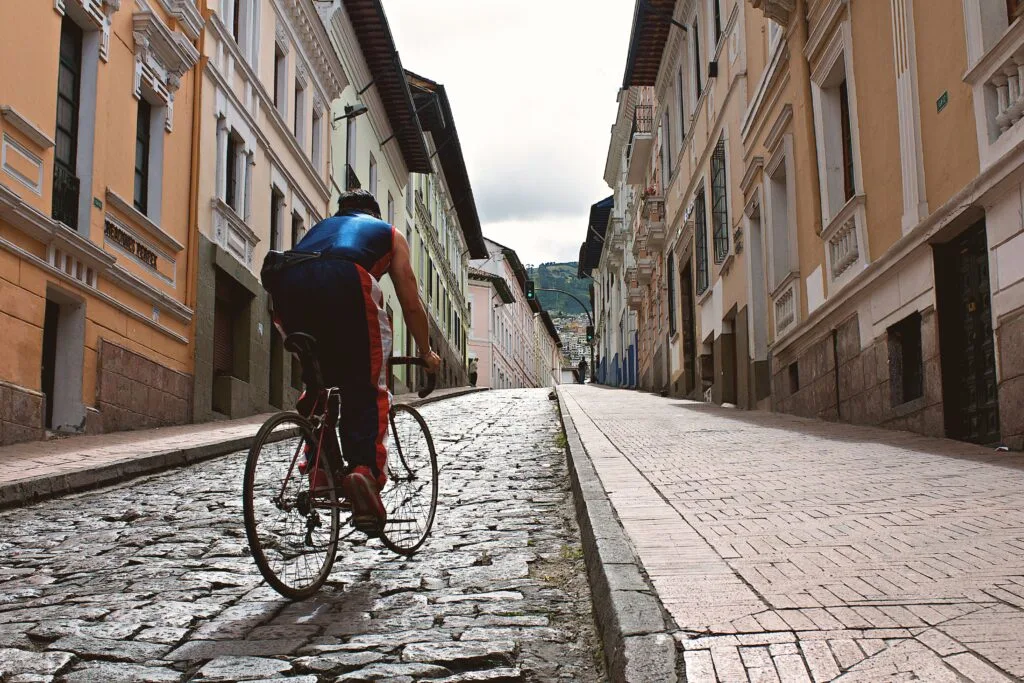
The AMT actively monitors cycle lanes to prevent motor vehicle encroachment and enforces delivery rider compliance. Helmet rules are enforced along central corridors, and riding on pedestrian sidewalks in historic districts, such as El Panecillo or the Centro Histórico, will draw immediate warnings or fines from agents.
Cuenca
Cuenca is widely regarded as one of South America’s most bicycle-friendly cities, boasting continuous riverfront paths along the Río Tomebamba and some integrated urban lanes.
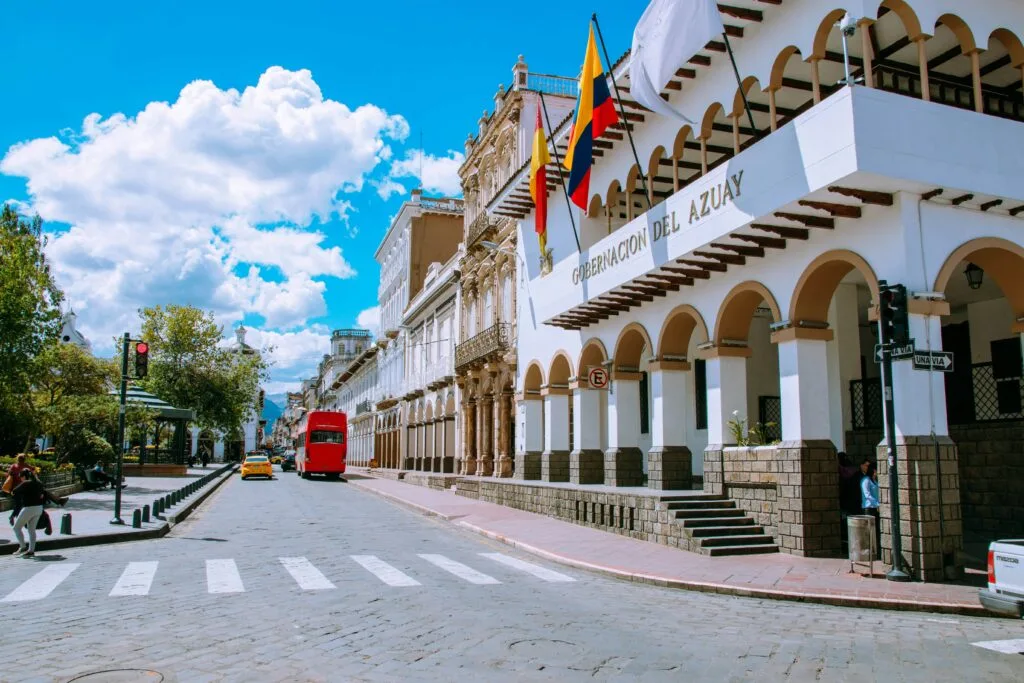
Managed by EMOV EP, Cuenca enforces homologated helmet regulations strictly and actively promotes smooth integration between cyclists, tramways (Tranvía de Cuenca), and pedestrians.
Guayaquil
In the coastal metropolis of Guayaquil, managed by the Agencia de Tránsito y Movilidad (ATM), riding conditions differ from those in the Andean cities.
Higher speeds and dense motor traffic make strict adherence to lane rules vital. ATM agents focus heavily on keeping motorists out of designated coastal ciclovías along the Malecón 2000 and major avenues, while monitoring e-bike speeds on pedestrian-adjacent paths.
Real-world enforcement and judicial interpretation
Understanding the written law is essential, but knowing how that law is interpreted in real life is equally critical when riding a bike in Ecuador.
Judicial system trends
Ecuadorian courts and traffic tribunals routinely uphold the vulnerable road user principle. In personal injury cases or property damage disputes, judges expect motor vehicle drivers to demonstrate that they exercised maximum caution near cyclists.
If a collision occurs because a driver failed to yield the right of way at an intersection or passed within the 1.5-metre safety buffer, judicial outcomes almost universally favour the cyclist, provided the rider was not under the influence or acting recklessly.
Police and traffic agent behaviour
Enforcement patterns vary markedly between major metropolitan centres and rural provinces:
- Urban Centres: Traffic agents in Quito, Cuenca, and Guayaquil actively monitor traffic light compliance, helmet usage, and light operation during night hours
- Rural and Mountain Pass Routes: On interprovincial highways, through remote Andean valleys, or across the high páramo, police presence is sparse and focused primarily on commercial trucking and heavy traffic control. In these areas, cyclists are largely expected to self-regulate
Public perception and road etiquette
Public awareness of cyclist rights has grown immensely across Ecuador, supported by active local cycling communities and public advocacy campaigns. While city drivers are increasingly accustomed to sharing the road, horn honking remains common practice.
In Ecuador, a short tap of the horn by a driver behind you is rarely an aggressive gesture; it is usually a warning signal that they are preparing to pass without giving you any space.
The Ecuadorian Coast.
Where you’ll find the very best food
Transit integration / Bicycles on public transport and storage rights

Ecuadorian law recognises that multi-modal transit is vital for sustainable travel. The Ley Orgánica de Transporte Terrestre includes specific provisions that guarantee integration between bicycles and public transit systems:
- Interprovincial and Regional Buses: Operators are legally required to transport bicycles in lower luggage compartments without charging exorbitant or predatory extra fees
- Urban Transit and Feeder Systems: Major municipal transport networks, such as Quito’s Metro and Cuenca’s Tranvía, allow bicycles onboard during specified non-peak hours or in dedicated multi-modal carriages
- Public Parking Facilities: Municipalities and public transport terminals are mandated to provide secure, free, and accessible bicycle parking spaces for commuters
Practical guidance for touring and commuting in Ecuador
Navigating Ecuador on two wheels is a rewarding adventure when backed by complete legal clarity.
By riding predictably, ensuring your bicycle is equipped with proper lights and reflectors, and respecting pedestrian spaces, you can enjoy everything this country has to offer—from volcanic passes to Amazonian foothills—with total confidence.
Quito.
Explore the Middle of the World
Take to the Andean roads with peace of mind

Read this far?
Cycling through Ecuador offers an extraordinary encounter with diverse landscapes, from the high, windswept tracks of the páramo to the bustling equatorial avenues of Quito and the historic riverfronts of Cuenca. However, the true freedom of independent travel comes from knowing that your presence on the road is backed by a firm, modern legal framework.
The reforms enacted by the National Assembly have solidified the position of non-motorised transport, ensuring that cyclists are treated not as an afterthought, but as a priority within the national mobility structure.
Understanding these legal realities transforms how you interact with traffic. While urban driving culture can feel assertive, knowing that drivers carry a statutory duty of care under the vulnerable road user doctrine provides genuine confidence when navigating complex junctions or busy roundabouts.
Whether you are embarking on a multi-month bikepacking expedition along the Trans Ecuador Mountain Bike Route or simply joining the thousands of local commuters taking advantage of Quito’s Sunday Ciclopaseo, preparation remains your best protection.
Equipping your bicycle with proper lighting, wearing a certified helmet, and riding with predictable road positioning allows you to focus entirely on the journey.
At Wheely Tyred, our commitment is to provide clear, grounded, and practical information that empowers you to explore the world on two wheels. By respecting local regulations and understanding your rights, you can experience the unmatched hospitality and geography of Ecuador with complete peace of mind.
Affiliate Disclaimer: Some of the links on Wheely Tyred are affiliate links. If you click through and make a booking or purchase, we may earn a small commission at no extra cost to you. We only recommend gear, tours, stays, and services we genuinely use, trust, and stand behind — our editorial independence always comes first. These commissions help keep our independent cycling guides and travel stories free to read. You can also buy me a coffee here — thanks for supporting the ride!
Frequently asked questions about the cycling laws in Ecuador
Yes, in major metropolitan jurisdictions. While national legislation sets overarching safety standards for certified headgear (cascos homologados), enforcement is carried out by municipal transit agencies. Cities like Quito, Cuenca, and Guayaquil strictly enforce helmet use on public roads and ciclovías. Riding without an approved helmet in these cities can result in an administrative fine equal to 5% of the Salario Básico Unificado (SBU), which is roughly $24 USD to $25 USD.
Yes. Under Article 204 of the national transit law, interprovincial bus companies are legally required to facilitate the transport of bicycles in their lower luggage bays. Operators cannot charge exorbitant or arbitrary extra fees for standard bicycles. Additionally, municipal transport networks, including the Quito Metro and the Tranvía de Cuenca, allow bicycles onboard during specified off-peak hours or inside designated multi-modal carriages.
If you ride between sunset and sunrise, or during heavy mist and rain in mountain passes, your bicycle must be fitted with a functioning white headlight at the front and a red taillight at the rear. Reflective strips on wheel rims or pedals are also legally required to ensure visibility from lateral angles.
Invading, blocking, or parking inside a designated ciclovía is a major traffic infraction under Article 390 of the Código Orgánico Integral Penal (COIP). Motorists who block cycle infrastructure face financial penalties and point deductions from their driving licence. If a cycle lane is blocked or unsafe to use, cyclists have the explicit legal right to merge into the main vehicle lane.
Standard pedal-assist e-bikes with a motor output that cuts off at 25 km/h are legally classified alongside conventional bicycles and have full access to ciclovías. However, throttle-driven electric bikes or light vehicles capable of higher speeds are subject to municipal speed limits and may be restricted to main carriageways rather than pedestrian-adjacent cycle tracks.
In Ecuadorian driving culture, a quick, light tap of the horn is rarely aggressive, but it is a warning. Drivers routinely use a brief toot to signal their presence before overtaking a cyclist on narrow mountain roads or urban streets without giving any space. It is best understood as a warning rather than a sign of hostility.
Ecuador.
Pure wonder on the equator.