The crown jewel of South Bohemia / Uncovering the top sights in Český Krumlov
Experience the magic of a pristine medieval town at your own pace, far beyond the reach of the rigid tour bus schedules
Český Krumlov rewards those who explore with a slow, deliberate pace
BEN FINCH
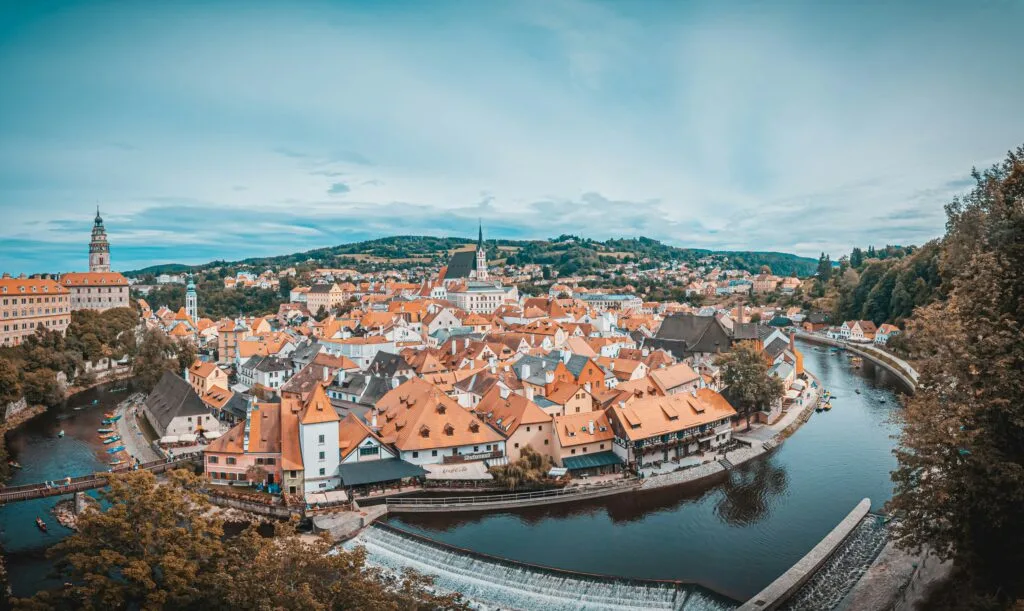
Nestled in a tight, sweeping meander of the Vltava River, Český Krumlov is a place where time appears to have stopped somewhere in the late Renaissance. For the independent traveller, arriving here feels like uncovering a brilliantly preserved secret, even if the town is rightfully famous across the globe.
Unlike those who are rushed off a coach and hurried through the cobbled streets behind an umbrella-wielding guide, visiting this UNESCO World Heritage site on your own terms allows you to truly absorb its atmosphere. You can linger over architectural details, enjoy a quiet coffee overlooking the water, and let the rich history of South Bohemia unfold before you.
The magic of Český Krumlov lies in its density. Within a highly compact historic centre, you will find centuries of aristocratic wealth, artistic rebellion, and architectural mastery. To truly understand this majestic town, you must explore its defining landmarks. These are the top attractions that demand your attention and reward those who explore with a slow, deliberate pace.
Český Krumlov’s essential highlights at a glance
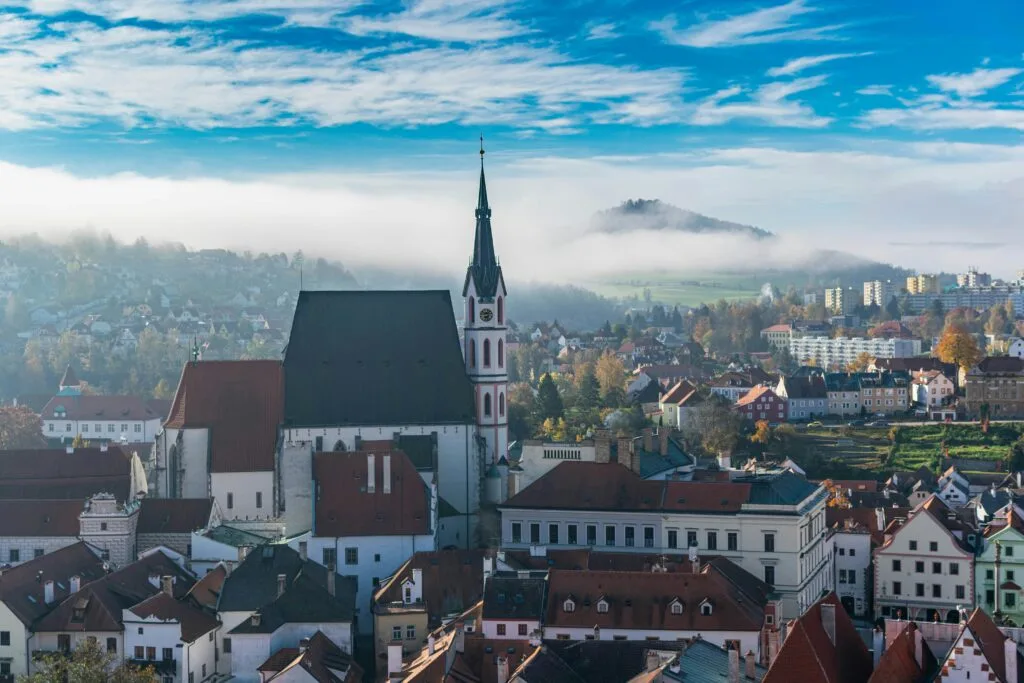
Český Krumlov is frequently victimised by its own beauty, often appearing more like a film set than a functioning town. To navigate the Disneyfication and find the substance beneath the souvenir shops, prioritise these:
- The State Castle & Chateau: A massive, multi-layered complex that serves as the town’s architectural anchor. Beyond the Renaissance frescoes, the Castle Tower provides the definitive view of the Vltava’s horseshoe bend, while the Bear Moat offers a somewhat surreal encounter with the castle’s ursine residents
- The Baroque Theatre: One of the most perfectly preserved theatres of its kind in the world. Access is strictly limited to maintain its fragile machinery and original scenery, making it a mandatory stop for anyone interested in the technical history of stagecraft
- The Cloak Bridge (Plášťový most): A staggering multi-story stone bridge supported by massive arches. It serves as a literal and metaphorical link between the castle’s residential quarters and the gardens, offering a perspective on 18th-century engineering that is best appreciated from the riverbanks below
- Egon Schiele Art Centrum: A sharp, modernist departure from the town’s medieval aesthetics. Housed in a former 16th-century brewery, this gallery explores the life and provocative work of Schiele, who lived and painted here, alongside rotating contemporary exhibitions
- St. Vitus Church: The town’s spiritual high point. This Gothic structure provides a quieter, more austere counterpoint to the flamboyant ornamentation of the castle, featuring impressive net vaulting and the final resting place of the powerful Rožmberk family
- The Latrán District: The historic neighbourhood located at the base of the castle. While heavily trafficked, its narrow alleys and hidden courtyards still contain traces of the town’s artisan past, provided you venture away from the main thoroughfare
- Mount Kleť: The independent escape. For those needing to burn off a litre of local beer, a hike (or chairlift) to the summit of the nearby Blanský Forest offers a vantage point that stretches as far as the Austrian Alps on a clear day
Prague.
There’s no other city like it
Český Krumlov State Castle and Chateau
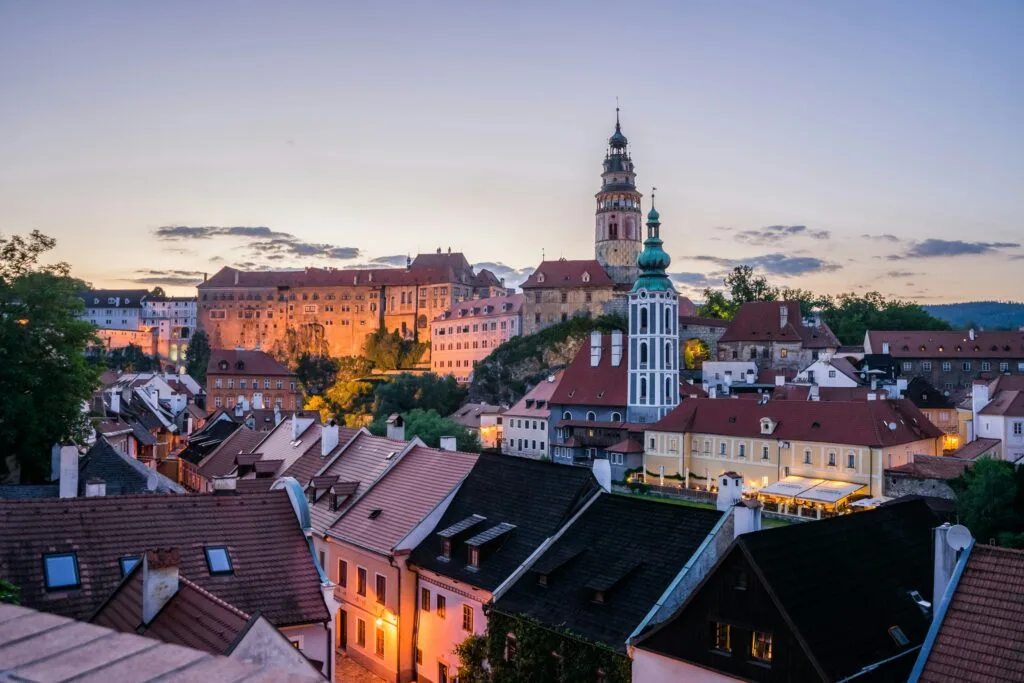
Dominating the skyline and stretching majestically across a rocky promontory, the Český Krumlov State Castle and Chateau is the second-largest castle complex in the Czech Republic, surpassed only by Prague Castle. Its sheer scale is mesmerising, comprising forty buildings and palaces, five sprawling courtyards, and an expansive baroque garden.
The castle is a visual timeline of European aristocratic history. Founded in the 13th century by the Vítkovci family, it truly flourished under the rule of the powerful Rosenberg dynasty, who transformed the austere Gothic fortress into a lavish Renaissance residence. As you walk through the courtyards, you will notice the intricate sgraffito facades, a technique that creates the illusion of three-dimensional masonry through scratched plaster.
One of the most famous, albeit unusual, traditions of the castle is the bear moat. Since the 16th century, the ruling families kept bears in the moat separating the first and second courtyards, a nod to their alleged lineage connecting them to the Italian Orsini family, whose name translates to bear.
Moving beyond the moat, the interior rooms offer a spectacular glimpse into the lives of the Eggenberg and Schwarzenberg families, complete with Flemish tapestries, Renaissance furnishings, and gilded carriages.
The Castle Tower
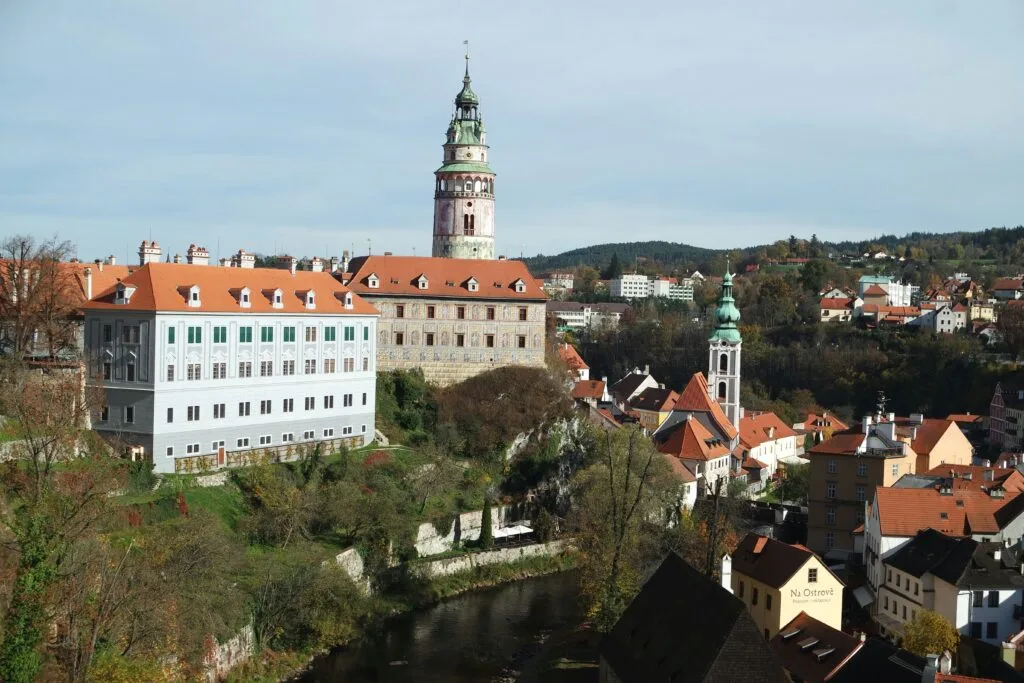
While technically part of the castle complex, the Castle Tower deserves its own dedicated attention as the undisputed symbol of the town. With its brightly painted, pastel-hued facade, the tower stands as a beacon guiding travellers from miles around. Originally built in the Gothic style in the 13th century, it was later given its signature Renaissance makeover, complete with an arcaded gallery and a copper onion dome.
For those willing to climb the 162 winding wooden steps, the reward is an unrivalled, 360-degree panoramic view of the region. From this vantage point, the unique geography of Český Krumlov becomes brilliantly clear.
You can watch the Vltava River loop back on itself, tightly embracing the historic centre below. The terracotta rooftops, the labyrinthine streets, and the rolling green hills of the Blanský Forest in the distance create a landscape that is deeply rewarding for any keen photographer or appreciative observer.
Bohemia.
Explore the heart of the Czech Republic
The Historic Inner Town
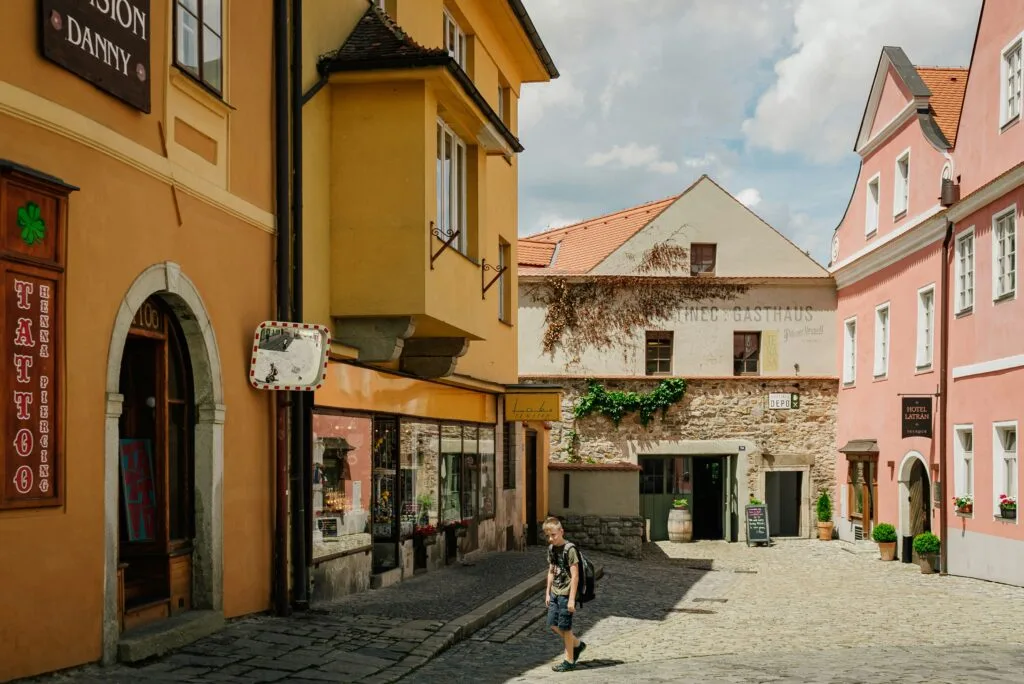
To experience the true pulse of Český Krumlov, you must descend from the castle heights and lose yourself in the Historic Inner Town. Connected to the castle district, known as Latrán, by a series of historic bridges, the inner town is entirely encircled by the meandering river.
At the very heart of this district lies Svornosti Square, a picturesque public space lined with immaculately preserved burgher houses featuring Gothic, Renaissance, and Baroque facades. In the centre stands a Plague Column topped with a statue of the Virgin Mary, erected as a gesture of gratitude after the town survived a devastating epidemic in the 17th century.
Wandering away from the main square reveals a maze of narrow, winding alleys. Because the town’s street plan has remained virtually unchanged since the Middle Ages, walking here is a genuine step back in time.
Without a strict itinerary to follow, you are free to discover hidden courtyards, artisan craft shops, and riverside cafes where you can watch rafters and canoeists navigating the gentle rapids of the Vltava.
St. Vitus Church
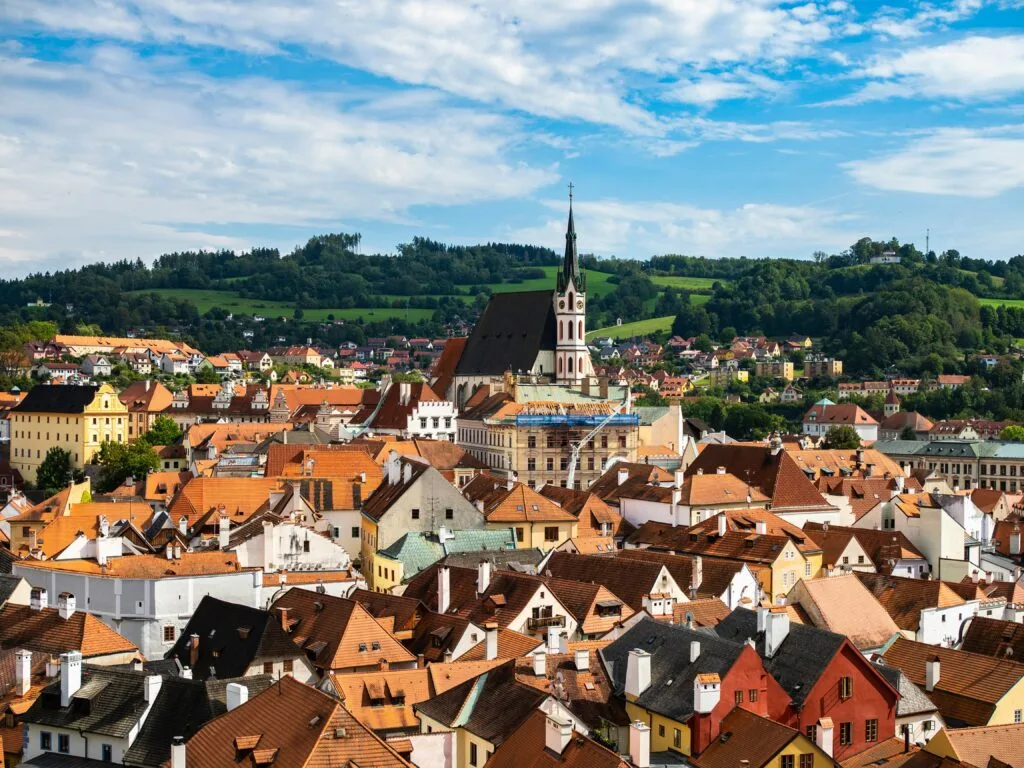
Rivalling the Castle Tower for dominance over the townscape is the slender, striking spire of St. Vitus Church. Built in the 15th century on the site of an older sanctuary, this magnificent late-Gothic structure is the spiritual heart of the town. Its steep, sweeping roofline and towering presence make it an essential focal point from almost any viewpoint.
Inside, the church features a grand, soaring nave supported by intricate net vaults that demonstrate the incredible skill of medieval stonemasons. The church is deeply intertwined with the history of the town’s ruling families. It served as the final resting place for several prominent members of the Rosenberg family, including the powerful William of Rosenberg.
The Baroque high altar, the neo-Gothic modifications, and the historic frescoes create a solemn but deeply beautiful atmosphere, offering a quiet, contemplative space away from the busier streets.
Kutná Hora.
The city of silver and skulls
The Baroque Theatre
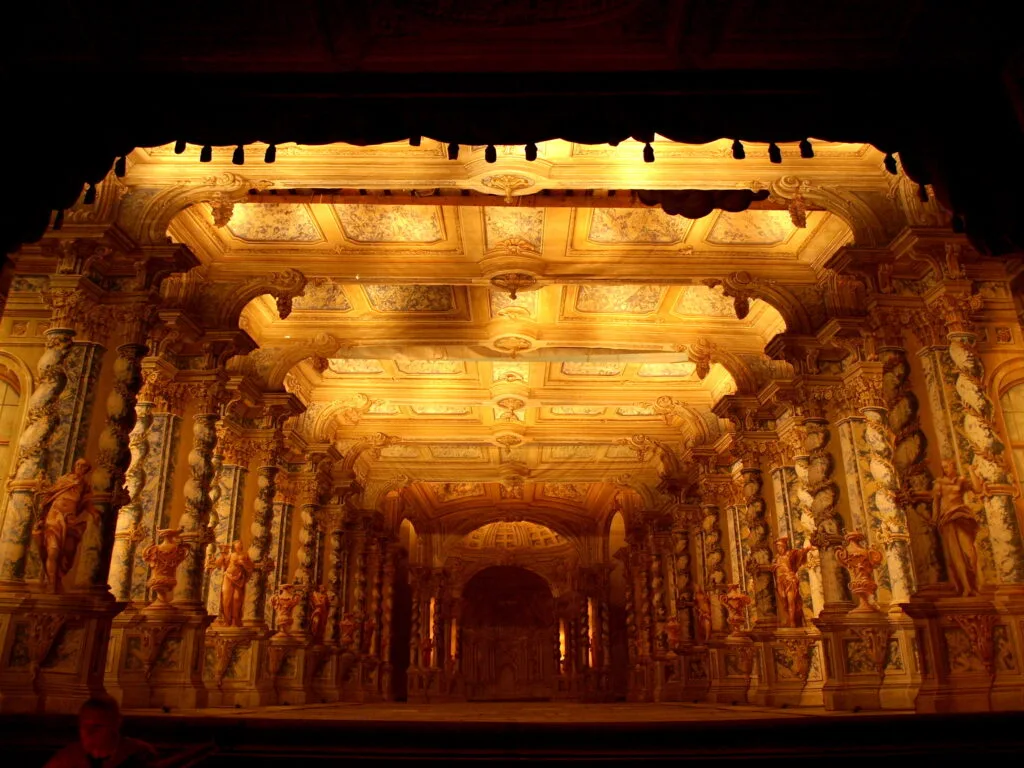
Hidden within the castle complex is a marvel of European cultural history: the Český Krumlov Baroque Theatre. Built in 1682 and exquisitely renovated in 1766, it is one of only two theatres of its kind in the entire world that remains fully intact, the other being the Drottningholm Palace Theatre in Sweden.
What makes this theatre so extraordinary is its state of preservation. It retains its original auditorium, stage, stage machinery, scenery, costumes, and even an extensive archive of period sheet music. The intricate wooden machinery beneath the stage allowed operators to change the massive painted backdrops in a matter of seconds, creating grand illusions of stormy seas, enchanted forests, and opulent palaces.
Because it is so delicate, the theatre is only used for performances on very rare occasions, but guided tours provide a fascinating look at how 18th-century special effects were brilliantly achieved through pulleys, ropes, and immense human effort.
Egon Schiele Art Centrum
While Český Krumlov is defined by its medieval and Renaissance architecture, it also holds a vital place in modern art history. The Egon Schiele Art Centrum, housed in a beautifully repurposed 16th-century brewery building, celebrates the life and work of the controversial Austrian Expressionist painter.
Schiele, a protégé of Gustav Klimt, had a deep personal connection to the town. His mother was born here, and he briefly relocated to Český Krumlov in 1911 to seek inspiration away from the constraints of Vienna. He produced some of his most striking and evocative townscapes during his stay, capturing the brooding, atmospheric energy of the historic streets.
Today, the gallery features a permanent exhibition detailing his life alongside rotating exhibitions of classical and contemporary 20th-century art. The vast, wooden-beamed halls of the former brewery provide a stunning contrast to the modern works on display, making it a vital stop for anyone with an interest in European art.
Moravia.
Welcome to wine country
Beyond Český Krumlov city limits / The freedom of the road
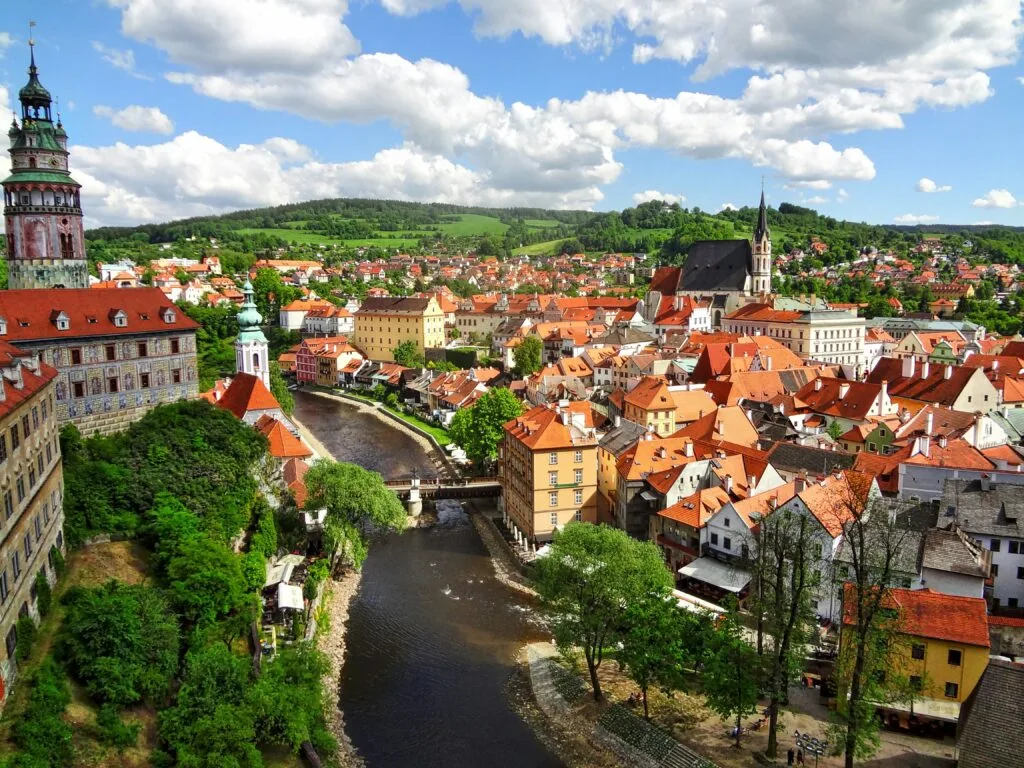
The true joy of independent travel is the ability to shift gears whenever the mood strikes. When you are not bound by a rigid group itinerary, the exploration does not have to end at the town borders. For those who favour a more active approach to travel, such as arriving with your own bicycle or hiring one locally, Český Krumlov serves as the perfect springboard into the lush landscapes of South Bohemia.
Leaving the cobbled streets behind, a short ride along the Vltava opens up a world of tranquil countryside. Just eight kilometres to the north lies the breathtaking Zlatá Koruna monastery, a remarkably preserved 13th-century Cistercian abbey tucked into a peaceful river valley. Pushing slightly further, roughly fifteen kilometres from the town centre, you will find the romantic, sprawling ruins of Dívčí Kámen castle, perched dramatically on a high rock above the confluence of the Vltava and Křemžský stream.
For those seeking a rigorous climb and spectacular views, the winding forest roads up to the summit of Mount Kleť, located just over ten kilometres away, offer an exhilarating challenge. When you travel on two wheels, you dictate the schedule, ensuring that every historic sight and hidden valley is experienced on your own terms.
Affiliate Disclaimer: Some of the links on Wheely Tyred are affiliate links. If you click through and make a booking or purchase, we may earn a small commission at no extra cost to you. We only recommend gear, tours, stays, and services we genuinely use, trust, and stand behind — our editorial independence always comes first. These commissions help keep our independent cycling guides and travel stories free to read. Thanks for supporting the ride!
Frequently asked questions about Český Krumlov attractions
While many attempt it, a few hours between bus transfers barely scratches the surface. To experience Krumlov with any degree of autonomy, stay overnight. The town transforms after 6:00 PM when the day-trippers depart, allowing you to inhabit the cobblestone streets without the elbow-to-elbow congestion.
The river is the town’s lifeblood, but it can get chaotic with party rafts during peak summer weekends. For a more dignified experience, rent a canoe or paddleboard on a weekday morning to navigate the town’s weirs and urban scenery at your own pace.
The tradition of keeping bears in the castle dates back to the 16th century, specifically to the Rožmberk family, who claimed a genealogical link to the Italian Orsini family (whose name means bear-like). It is a living, albeit controversial, relic of feudal status.
Generally, if a restaurant is aggressively advertising a medieval experience with costumes, you are paying for theatre rather than culinary excellence. For an authentic Moravian or Bohemian meal, look for the taverns tucked into the cellars of the Latrán district that don’t have menus printed in six languages on the pavement.
Winter in Český Krumlov is spectacularly atmospheric. While the castle interiors and the Baroque theatre close for the season (typically November through March), the castle grounds and the town itself remain open. The lack of crowds and the potential for snow on the terracotta roofs make it a photographer’s—and a misanthrope’s—dream.
The Student Agency (RegioJet) or FlixBus coaches are the most efficient public options from Prague, taking about three hours. If you prefer the rails, the train journey involves a change in České Budějovice, and it offers a much more scenic, slow-travel perspective of the South Bohemian countryside.
Czechia.
Discover Czechia / History reimagined