Top Attractions in Brno: The Ultimate Guide to Czechia’s Second City
Uncover the rich history, striking architecture, and hidden underground of Moravia’s vibrant capital
When travellers think of the Czech Republic, their minds inevitably wander to the crowded, spectacular streets of Prague. However, those who look a little further east to the region of Moravia discover a city that hums with an entirely different, brilliantly authentic energy. Brno is the country’s second-largest city, a dynamic university hub that perfectly balances deep medieval history with boundary-pushing modernist architecture and a remarkably innovative culinary scene.
For the independent traveller, Brno is a revelation. It is a destination that does not require you to follow a raised umbrella or shuffle through tightly packed tour groups to appreciate its grandeur. The city is designed to be absorbed at your own pace. Its compact historical centre and surrounding neighbourhoods are incredibly accessible, making it an absolute joy to navigate under your own steam.
Whether you are marvelling at towering Gothic cathedrals, delving into secret subterranean labyrinths, or admiring UNESCO-listed functionalist design, Brno rewards curiosity. To help you build your perfect self-guided itinerary, we have detailed the top attractions in Brno that simply cannot be missed.
Špilberk Castle
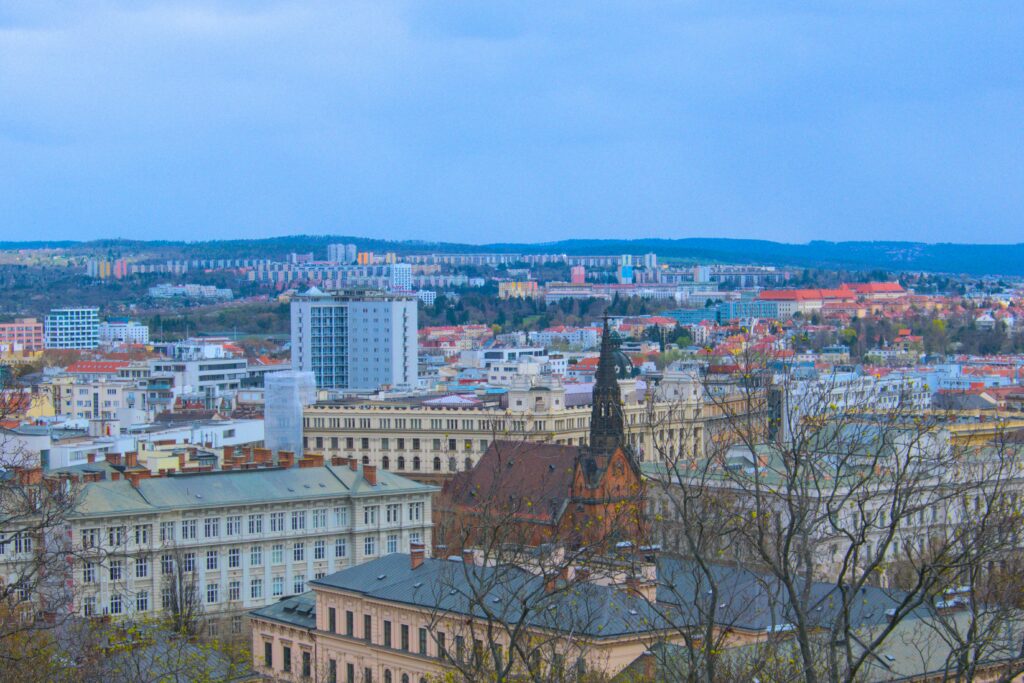
Commanding the skyline from a steep, park-covered hill right in the centre of the city, Špilberk Castle is perhaps the most iconic symbol of Brno. Founded in the middle of the thirteenth century by the Czech king Přemysl Otakar II, the structure began its life as a major royal castle and the seat of the Moravian margraves. However, its history is marked by a series of dramatic transformations.
By the seventeenth and eighteenth centuries, Špilberk had been converted into a massive Baroque fortress, heavily fortified to withstand brutal sieges. It became the most important military stronghold in Moravia. Yet, the castle is most infamous for its later role as a prison. Throughout the eighteenth and nineteenth centuries, its dark, vaulted casemates held some of the most prominent political prisoners in the Austro-Hungarian Empire, including Italian Carbonari and Polish revolutionaries, earning it the dark reputation as the harshest prison in Europe.
Today, visitors can explore these very casemates, walking through the chilling underground cells that offer a stark reminder of the site’s grim past. Above ground, the castle functions as the Brno City Museum, hosting various cultural exhibitions. Taking the time to walk the perimeter walls is highly recommended, as it provides sweeping, unobstructed views of the city below, allowing you to map out the historical centre from a breathtaking vantage point.
Prague.
There’s no other city like it
Cathedral of St. Peter and Paul
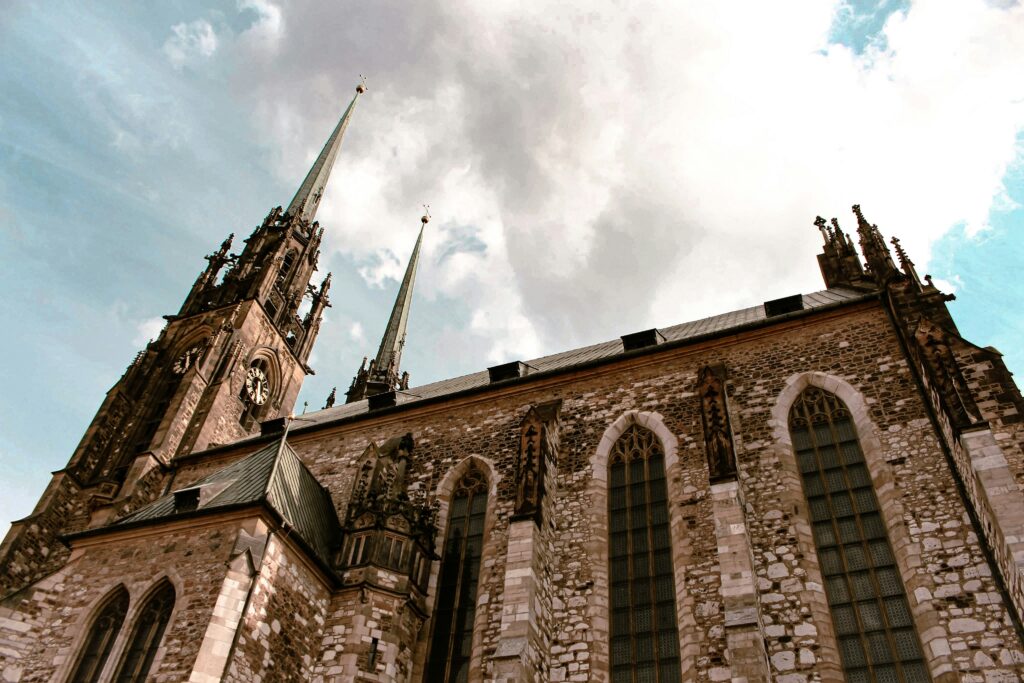
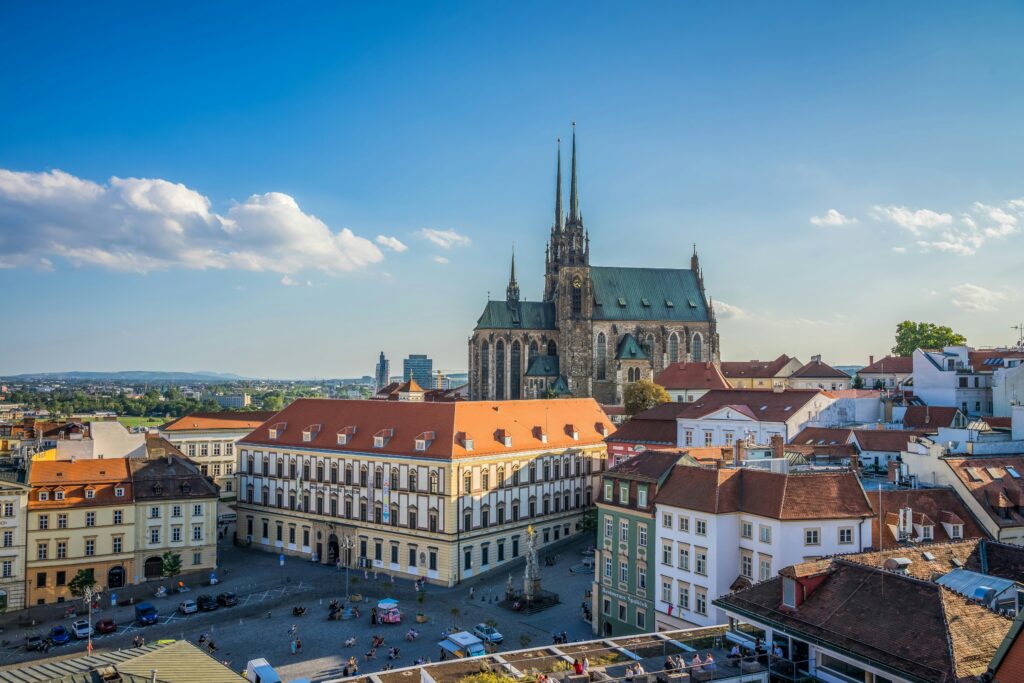
Situated on the prominent Petrov Hill, the Cathedral of St. Peter and Paul is a magnificent feat of architecture that dominates the Brno cityscape. Its towering twin spires, which reach eighty-four metres into the sky, were actually added in the early twentieth century, but the core of the building boasts a rich history dating back to the eleventh century. The cathedral is a stunning mix of original Romanesque foundations, soaring Gothic elements, and an ornately decorated Baroque interior.
Beyond its architectural brilliance, the cathedral is famous for a highly unusual tradition: its bells ring midday at eleven in the morning instead of twelve. This quirk stems from a legendary event during the Thirty Years’ War in 1645. The Swedish army, led by General Torstenson, had besieged Brno for months. Frustrated by the city’s resilience, Torstenson declared that if his troops could not breach the walls by midday the following day, he would abandon the siege. The astute citizens of Brno, upon hearing this, decided to ring the cathedral bells an hour early. The Swedish army retreated, and the city was saved.
Visitors are welcome to explore the stunning interior, featuring the Kapistránka pulpit and intricately carved altars. For a small fee, you can also climb the towers. The ascent is well worth the effort, offering a spectacular, panoramic reward that highlights the contrasting red roofs and modern developments of the Moravian capital.
Moravia.
Czechia’s best kept secret
Villa Tugendhat
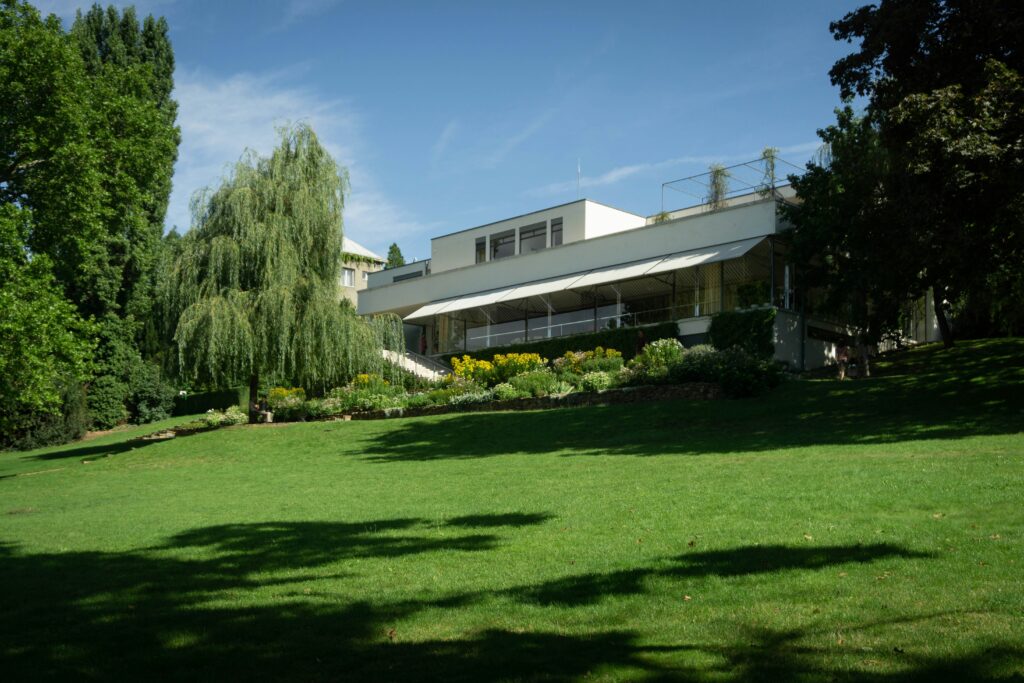
Leaving the medieval history of the centre behind, a journey to the affluent Černá Pole neighbourhood brings you to an entirely different era of architectural mastery. Villa Tugendhat, designed by the pioneering architect Ludwig Mies van der Rohe and completed in 1930, is widely considered one of the most important residential buildings in the world. As a UNESCO World Heritage site, it is a flawless example of functionalist architecture.
Commissioned by the wealthy Jewish industrialists Fritz and Greta Tugendhat, the villa was revolutionary for its time. Mies van der Rohe utilised an iron framework, which allowed him to dispense with supporting walls and create vast, open-plan living spaces. The design seamlessly integrates the interior with the exterior, most notably through a colossal glass wall that retracts entirely into the basement at the push of a button. The interior is famously adorned with luxurious materials, including a striking curved wall of Moroccan onyx that glows fiery red when hit by the setting sun.
Because of its global significance, tickets to tour the interior of Villa Tugendhat must be booked months in advance. However, as an independent traveller managing your own schedule, planning your day around this highly sought-after reservation is incredibly rewarding. Even if you only secure access to the meticulously landscaped gardens, witnessing the exterior of this modernist marvel is an essential Brno experience.
The Brno underground
To truly understand Brno, you must look beneath its surface. The city boasts a vast and fascinating network of subterranean spaces that have only been opened to the public in recent years. Among the most remarkable is the Ossuary beneath the Church of St. James. Discovered entirely by accident during an exploratory dig in 2001, it is the second-largest catacomb in Europe, surpassed only by the catacombs of Paris. The ossuary contains the carefully arranged remains of over fifty thousand people, victims of plague and cholera epidemics, as well as casualties of the Thirty Years’ War. It is a sobering, deeply moving site.
Just a short distance away lies the Labyrinth Under the Vegetable Market. This intricate network of medieval cellars and passageways was originally created to store fresh produce, mature wine, and provide shelter during times of war. Today, visitors can explore the restored tunnels, which feature historic displays including an alchemist’s laboratory and traditional wine cellars.
For a more modern historical experience, the 10-Z Bunker offers a glimpse into the paranoia of the Cold War. Built as a highly classified nuclear fallout shelter for the city’s political elite, the bunker can now be explored at your own pace. Wandering these echoing, atmospheric underground spaces provides a layer of historical context that completely transforms your understanding of the city above.
Mikulov.
The castle on the hill
Old Town Hall and the Brno Dragon
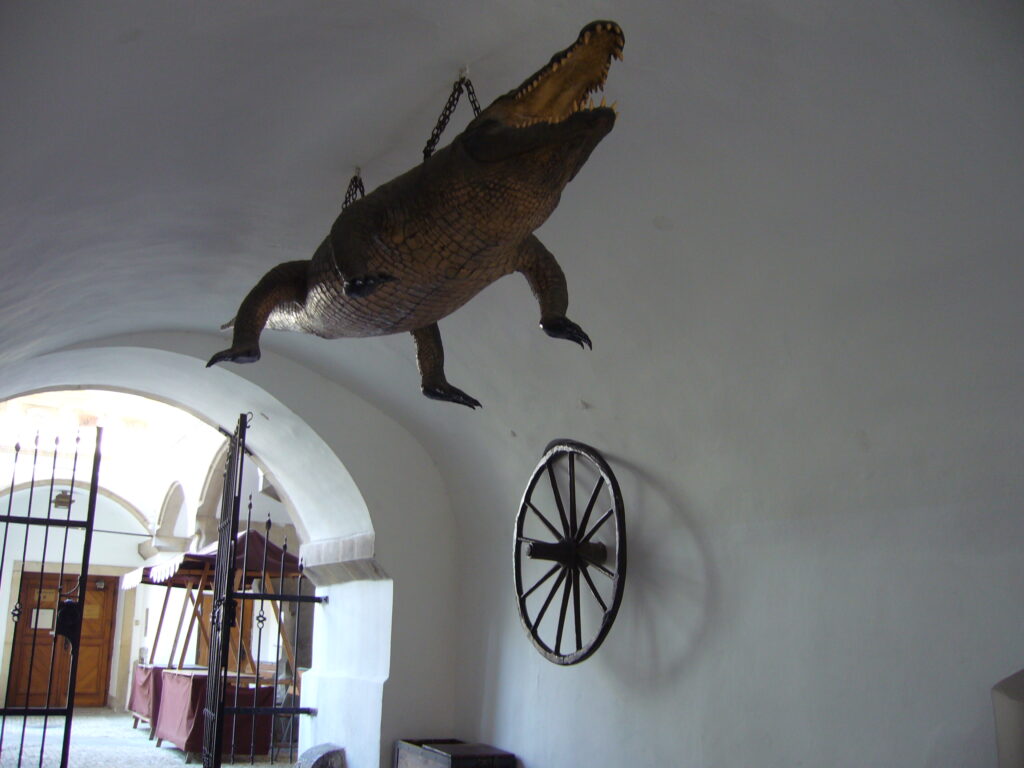
The Old Town Hall is the oldest secular building in Brno and serves as the epicenter of the city’s rich tapestry of legends. As you approach the building, you are immediately struck by its ornate Late Gothic portal, designed by the sculptor Anton Pilgram.
If you look closely at the central pinnacle above the statue of Justice, you will notice that it is distinctly crooked. Legend dictates that Pilgram purposely built it this way as an act of revenge after the city council attempted to shortchange him for his work.
Walking through the passageway of the Old Town Hall brings you face-to-face with Brno’s most famous resident: the Brno Dragon.
Suspended from the ceiling is a large, taxidermied crocodile. According to local lore, this fearsome creature once terrorised the citizens living along the nearby Svratka River until it was cleverly defeated by a local butcher who fed it a carcass laced with unslaked lime.
In reality, the crocodile was likely a gift from a visiting Turkish dignitary in the seventeenth century, but the myth remains a beloved part of the city’s identity.
After paying your respects to the dragon, climbing the sixty-three-metre tower of the Old Town Hall is a must. It offers arguably the best central viewpoint in the city, looking directly over the bustling squares and historic rooftops below.
Freedom Square and the Astronomical Clock
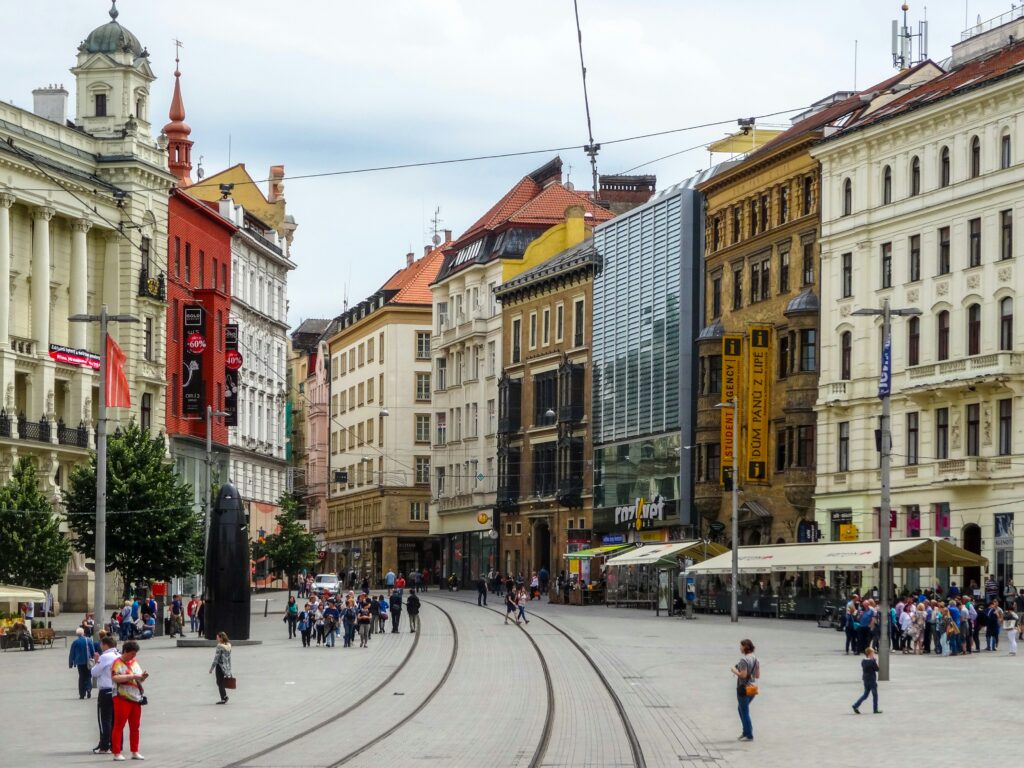
Freedom Square, or Náměstí Svobody, is the vibrant, pulsating heart of Brno. It is an irregularly shaped, triangular plaza that has served as the city’s main gathering point for centuries. Surrounded by a mix of historic Renaissance facades and grand modern buildings, the square is constantly alive with activity, hosting seasonal markets, festivals, and the daily hum of city life.
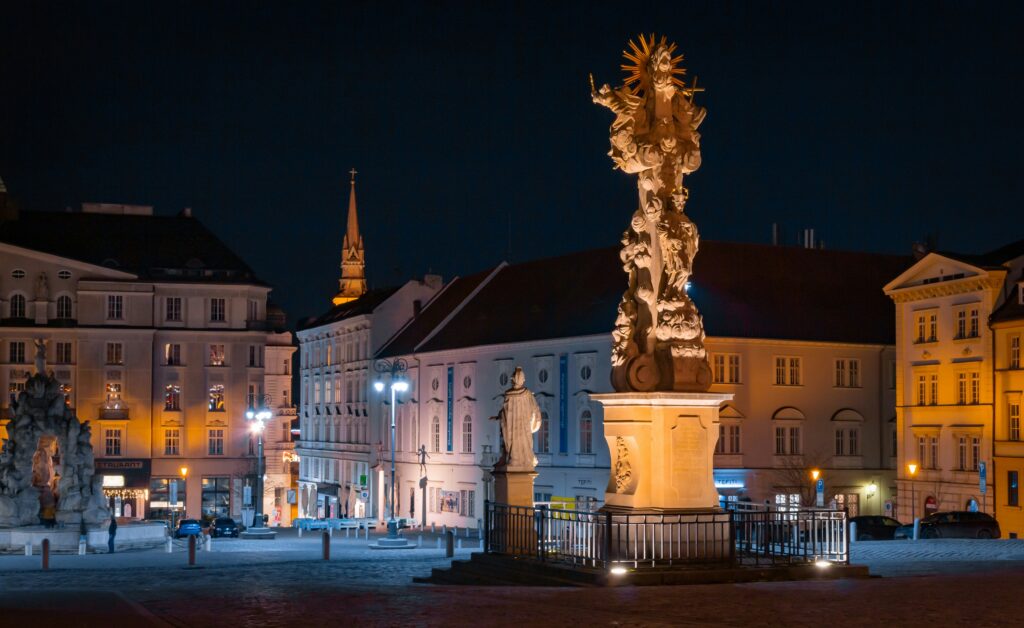
The square is home to a beautiful early Baroque plague column, but the attraction that draws the most attention is the Brno Astronomical Clock. Installed in 2010 to commemorate the city’s victorious defence against the Swedish army, the clock is a striking, controversial piece of modern art made from black African granite. Its shape, intended to resemble a bullet, is often the subject of humorous local debate.
Every day at eleven in the morning—tying into the legend of the cathedral bells—a complex mechanism inside the monument releases a single glass marble. The marble travels down one of four internal tracks, and spectators gather around the openings, hoping to catch the marble and take it home as a unique, free souvenir. It is a quirky, thoroughly modern addition to a highly historic space, perfectly encapsulating the unique character of Brno.
Bohemia.
Enter the heart of Czechia
Experience Brno your way
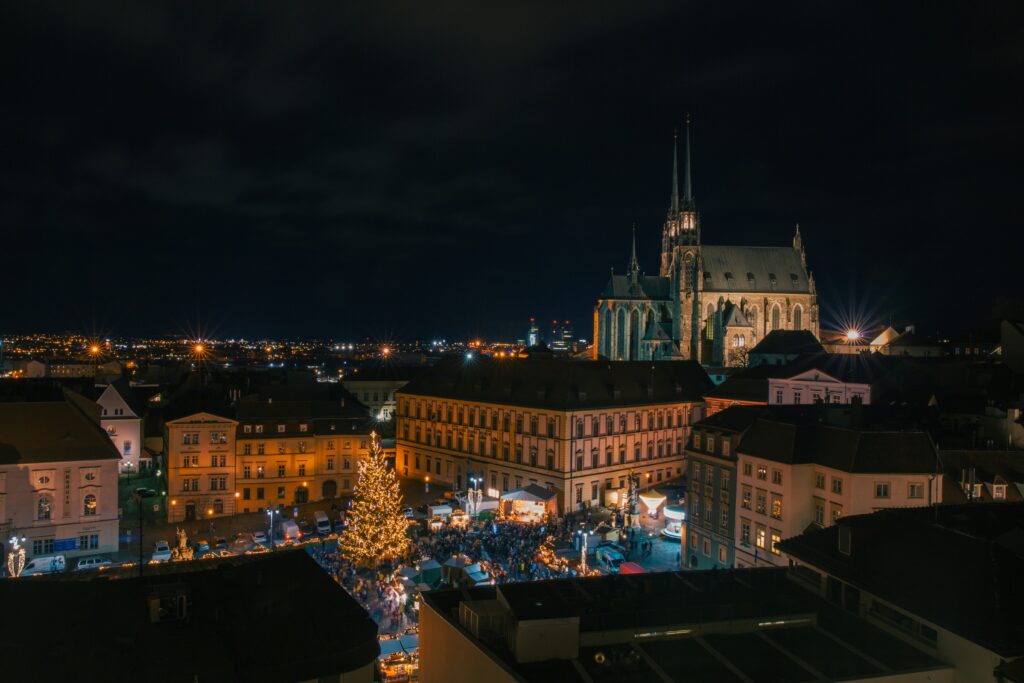
Brno is not a city that reveals all its secrets at a quick glance; it requires time, independence, and a willingness to explore. It is a destination that deeply respects the self-guided traveller. When you dictate your own itinerary, you have the freedom to linger in the echoing chambers of Špilberk Castle, wait patiently for the marble to drop in Freedom Square, and truly absorb the atmosphere of Moravia’s capital.
At Wheely Tyred, we champion the spirit of independent travel. We believe the best way to connect these incredible landmarks is by taking control of your own journey, ideally by travelling by bike. Cycling allows you to seamlessly transition from the historical centre to the striking landscapes that lie just beyond the city limits.
Within a short 20-kilometre radius, you can escape the urban hum for the tranquil Brno Reservoir, explore the medieval ramparts of Veveří Castle, or head south along the flat, scenic river paths to the magnificent Benedictine Monastery in Rajhrad. For those seeking nature, the dramatic limestone cliffs of the Moravian Karst or the peaceful trails of Mariánské údolí are easily reachable for a half-day excursion.
Get out of the car, embrace the freedom of the open road, set your own pace, and discover the top attractions of Brno and its surrounding countryside exactly the way you want to.
Discover Czechia on your terms.
Explore the country’s beauty at your own pace